





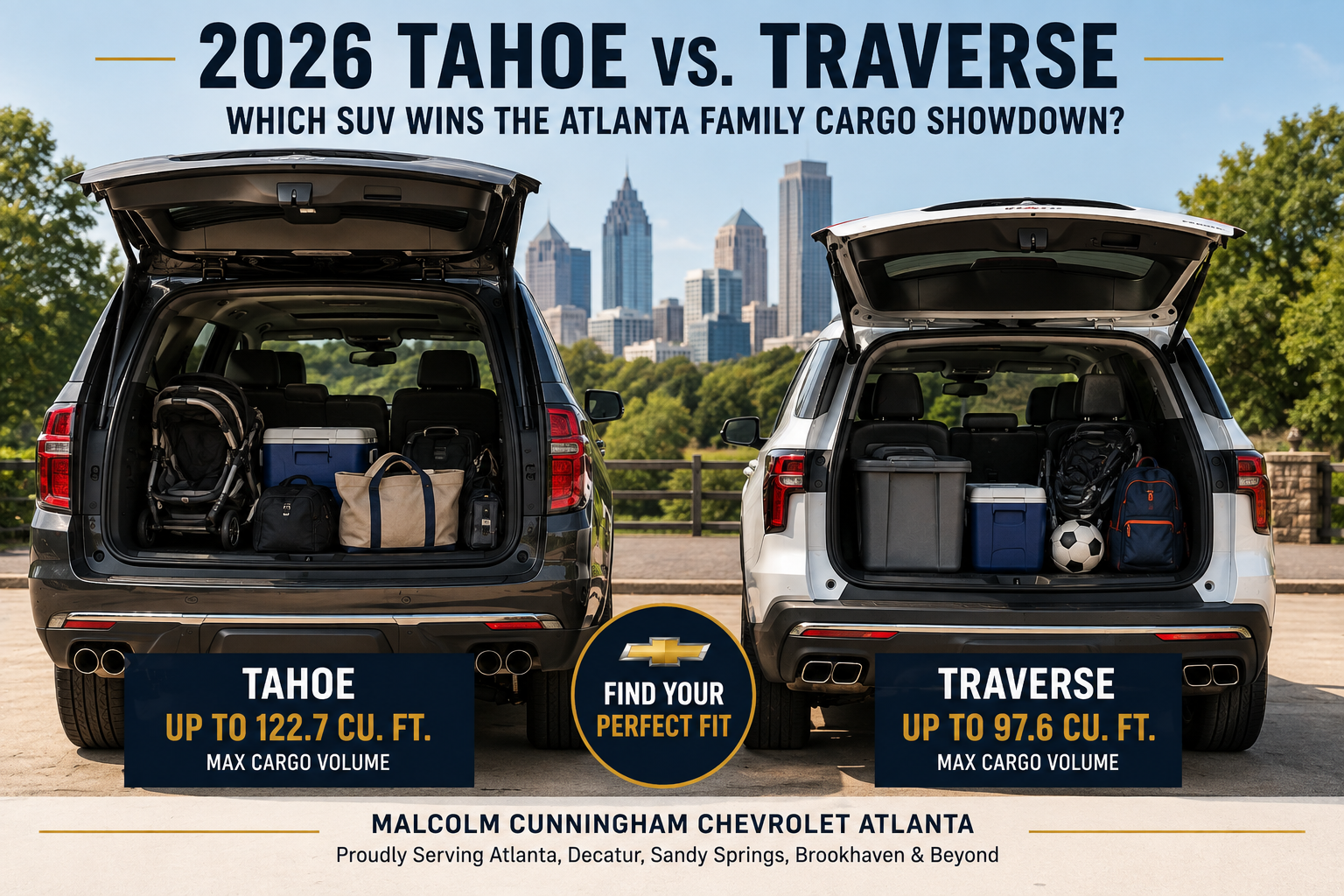
Picture this: you’re in the Costco parking lot off Cumberland Boulevard, and the back of your SUV is already half-full with soccer gear and a double stroller — and you haven’t even started loading groceries. For Atlanta families juggling weekend tournament bags, Piedmont Park picnic hauls, and the inevitable Home Depot run, cargo space isn’t a luxury spec on a window sticker — it’s the difference between one trip and two. The 2026 Chevrolet Traverse offers 22.9 cubic feet of cargo room behind its third row and up to 97.6 cubic feet with seats folded 1, while the 2026 Tahoe stretches that maximum figure considerably further, giving families in Decatur, Sandy Springs, and Brookhaven a meaningful choice to make before signing.
At Malcolm Cunningham Chevrolet Atlanta, we walk families through this exact comparison almost every weekend on our lot. We’ve loaded strollers, coolers, and flat-pack furniture into both the Tahoe and the Traverse side by side so our neighbors can see — not just read about — what fits and what doesn’t. The 2026 Chevrolet Tahoe and the 2026 Chevrolet Traverse represent Chevrolet’s two distinct approaches to family SUV cargo capacity, with the Tahoe delivering a larger maximum volume suited to full-size hauling needs and the Traverse offering a more compact footprint with competitive behind-third-row storage. In this guide, we’ll break down every cubic foot across seating configurations, compare how the AutoSense power liftgate works in each model, and help you figure out which SUV actually matches the way your Atlanta family lives — not just what looks good on a spec sheet.
2026 Tahoe vs. Traverse Cargo Space: The Numbers That Actually Matter
The 2026 Chevrolet Tahoe and 2026 Chevrolet Traverse are both built to haul families and their stuff, but the cargo volume gap between them is significant — and which SUV “wins” depends entirely on how your household uses the space behind the third row on a Tuesday afternoon versus a Saturday road trip.
The short answer
The 2026 Chevrolet Tahoe offers roughly 122.7 cubic feet of maximum cargo volume with its rear seats folded, while the 2026 Chevrolet Traverse provides approximately 97.6 cubic feet in the same configuration 1. Behind the third row with all seats upright, the Tahoe delivers about 25.5 cubic feet versus the Traverse’s 22.9 cubic feet 1. For large Atlanta families who regularly load strollers, sports bags, and Costco runs into their SUV, the Tahoe provides a clear advantage in raw volume — but the Traverse closes the gap when you factor in its more compact footprint for Sandy Springs parking decks and Decatur side streets.
Usable cargo space is the real-world volume you can access without folding or rearranging any seats — the everyday trunk area behind your last occupied row. This is different from maximum cargo volume, which represents the total cubic feet available when you fold every rear seat flat. We find that Atlanta families shopping on our lot often fixate on the maximum number, but it’s usable cargo space that determines whether your double BOB stroller fits behind the third row without a wrestling match.
One pattern we see repeatedly at our Atlanta dealership: families with three or more kids who keep all three rows occupied daily need every inch of that behind-third-row space, and the Tahoe’s approximately 25.5-cubic-foot advantage in that configuration makes a tangible difference. The Traverse’s 22.9 cubic feet behind all seats 1 is still workable for most gear, but tighter when bulky items like hockey bags or Pack ‘n Plays enter the equation.
Seating Configurations Change Everything: How Folding Rows Reshape Your Cargo Math
Those headline cubic-foot numbers only tell part of the story, because the real cargo calculus shifts dramatically the moment you start folding seats — and Atlanta families rarely use just one seating configuration all week. Here’s how the two SUVs compare across the configurations that matter most:
| Configuration | 2026 Chevrolet Tahoe | 2026 Chevrolet Traverse |
|---|---|---|
| Behind 3rd Row (all seats up) | 25.5 cu. ft. | 22.9 cu. ft. 1 |
| 3rd Row Folded | 72.5 cu. ft. | 56.6 cu. ft. 1 |
| 2nd & 3rd Rows Folded (max) | 122.7 cu. ft. | 97.6 cu. ft. 1 |
The 2026 Chevrolet Traverse cargo volume changes from 22.9 cubic feet behind the third row to approximately 97.6 cubic feet maximum when all rear rows are folded flat 1. The Tahoe’s jump is even more dramatic — roughly a 97-cubic-foot swing between all-seats-up and fully-flat configurations. That mid-range “third row folded only” number is the one our sales team in Atlanta calls the Weekend Configuration, because it reflects how most suburban families actually use their SUV on a Piedmont Park Saturday — five passengers up front and middle, with the entire cargo bay open for coolers, blankets, and a wagon.
Weekend Configuration is the cargo volume available when only the third-row seats are folded flat, preserving full second-row seating for passengers. This middle-ground measurement matters more than maximum volume for most families because you’re almost never driving around Atlanta with zero rear passengers.
For road trips from Atlanta down I-75 to the Florida coast, the Tahoe’s advantage in third-row legroom and the deeper cargo well behind that third row mean passengers and luggage coexist more comfortably. The Traverse, being a crossover-based platform, offers a lower cargo floor that makes loading and unloading heavier items — like camping gear for trips up to North Georgia — noticeably easier on your back.
How We Help Atlanta Families Pick the Right Fit at Malcolm Cunningham Chevrolet
Knowing the numbers is one thing — knowing which numbers matter for your family is where our team’s experience makes the difference.
💡 Pro Tip: Both the 2026 Tahoe and Traverse offer Chevrolet’s AutoSense power liftgate, which opens hands-free when it detects your key fob as you stand behind the vehicle. But the Tahoe’s liftgate opens to a higher clearance height, meaning tall items like a folding wagon or a Costco shelving unit can slide in without tilting. Ask our team to demo both liftgates with your specific cargo during your visit.
Our approach goes beyond the trunk. We walk families through the cargo management systems in both vehicles — the Tahoe’s available configurable rails and tie-downs versus the Traverse’s underfloor storage bins — and help match features to lifestyle. Trade professionals in Brookhaven hauling tool cases need different solutions than a Sandy Springs family of six heading to Lake Lanier every weekend.
Malcolm Cunningham Chevrolet Atlanta maintains a robust on-site inventory of both 2026 Tahoe and Traverse trims, including in-transit units. We also offer trade-in evaluations on the spot for families upgrading from an older SUV, so you can walk in with your current vehicle and leave with a clear picture of your monthly payment on either model.
Cargo Space Myths That Trip Up Atlanta SUV Shoppers
After walking hundreds of families through side-by-side comparisons, we’ve noticed the same misconceptions popping up again and again — and they can steer you toward the wrong SUV if nobody clears them up.
❌ Myth: Maximum cargo volume is the only number that matters when choosing between the Tahoe and Traverse.
✅ Reality: Maximum cargo volume represents total space with every rear seat folded flat — a configuration most families rarely use on a daily basis. Usable cargo space is the volume available behind the last occupied row of seats during typical driving, which for most Atlanta families with three or more passengers means the area behind an upright third row. The Traverse offers 22.9 cubic feet in that everyday scenario 1, while the Tahoe provides a noticeably deeper cargo floor behind its third row. The practical difference shows up when you’re loading after-school pickups, not when the SUV is empty.
❌ Myth: The Traverse and Tahoe have identical cargo management systems because they’re both Chevrolets.
✅ Reality: The 2026 Chevrolet Tahoe and Traverse feature different cargo management approaches tailored to their respective body-on-frame and unibody architectures. The Tahoe’s flat-folding third row creates a nearly level load floor suited for heavy or rigid items, while the Traverse uses a split-folding design optimized for flexible, mixed-use loading. Understanding which system matches your lifestyle is something our Chevrolet specialists discuss during every comparison walk-through.
Another pattern we see: families assume a bigger SUV automatically means worse fuel economy around Atlanta’s stop-and-go corridors on I-285 and GA-400. The gas-engine Tahoe is EPA-estimated at 16 to 17 mpg combined versus the Traverse’s 21 to 22 mpg combined, but the Tahoe’s available 3.0L Duramax diesel narrows that gap substantially, with an EPA-estimated combined figure in the low-to-mid 20s. We always recommend comparing total cost of ownership — not just sticker price — which is why our financing team builds out real monthly scenarios for both models.
Looking Ahead: Which 2026 Chevy SUV Fits Your Atlanta Family’s Next Chapter?
Now that we’ve cleared up the most common misconceptions, let’s talk about how to turn all of this research into a confident decision. The 2026 Chevrolet Tahoe offers greater maximum cargo volume and a deeper behind-third-row cargo well suited for large families who frequently haul bulky gear, while the 2026 Traverse delivers strong cargo capacity in a more maneuverable footprint ideal for families navigating tighter parking in Midtown, Buckhead, and downtown Atlanta. Choosing between them comes down to how you actually live, not which spec sheet looks more impressive.
Here’s what we’re advising Atlanta-area families to consider right now:
- Growing families expecting a third child or regularly carpooling should lean Tahoe — the cargo volume behind a fully occupied third row gives you breathing room that compounds over years of use.
- Urban-suburban commuters in Sandy Springs or Brookhaven who need a capable family hauler but park in tighter garages may find the Traverse hits the sweet spot between space and maneuverability.
- Road-trip families driving to Hilton Head, the North Georgia mountains, or Gulf Shores should factor in third-row legroom alongside cargo — the Tahoe’s longer wheelbase delivers more comfort for passengers and gear simultaneously.
- Budget-conscious shoppers should ask our financing team about current 2026 incentives. Malcolm Cunningham Chevrolet Atlanta offers tailored financing and trade-in evaluations that can make either model more accessible than you’d expect.
We keep a strong rotation of in-transit and on-lot 2026 Tahoe and Traverse inventory specifically because Atlanta families are actively cross-shopping these two models. If you’re ready to move from research to a real comparison, stop by our lot or give us a call — we’ll have both SUVs pulled up and ready for your Weekend Load Test before you finish your coffee.
Conclusion
| 📌 Key Takeaway | Why It Matters |
|---|---|
| The 2026 Tahoe offers roughly 25 more cubic feet of maximum cargo than the Traverse | Full-size families need that extra room. |
| The Traverse’s 97.6 cu. ft. maximum capacity handles most daily needs efficiently 1 | Compact footprint suits Atlanta’s tighter neighborhoods. |
| Strollers and coolers don’t read brochures | Real-world fit beats spec sheets — load your actual gear before you decide. |
The 2026 Tahoe wins the raw cargo war, but the Traverse punches well above its size class for Atlanta families who don’t need full-size volume every day. The right choice depends entirely on how you actually use the space — weekend tournament gear is a different equation than a Tuesday Trader Joe’s run through Brookhaven. The 2026 Chevrolet Tahoe offers the most versatile cargo solution for large families who frequently haul oversized loads, while the Traverse delivers a compelling balance of space and maneuverability for metro Atlanta driving. Our team will walk you through every seating configuration, run you through current financing options, and connect your trade-in value directly to a 2026 Tahoe or Traverse from our on-site inventory.
Ready for your Weekend Load Test? Compare both SUVs side by side on our lot.
Browse Tahoe & Traverse Inventory? Frequently Asked Questions
6 questions optimized for rich results.
📚 Sources
- 1 Edmunds’ 2026 Chevrolet Traverse features and specifications list cargo volume behind the third row, behind the second row, and maximum with all rear seats folded. — 2026 Chevrolet Traverse Specs & Features | Edmunds

