




Malcolm Cunningham Chevrolet Atlanta

Blog

2026 Tahoe vs. Traverse: Which SUV Wins the Atlanta Family Cargo Showdown?

2026 Tahoe vs Traverse
MCMalcolm Cunningham Chevrolet Atlanta
Alpharetta · Atlanta · Roswell · Cumming

Compare 2026 Tahoe vs Traverse cargo space with real cubic-foot breakdowns. Malcolm Cunningham Chevrolet Atlanta breaks down which SUV fits your family's gear.

⏱ 11 min read|2,488 words

Picture this: you're in the Costco parking lot off Cumberland Boulevard, and the back of your SUV is already half-full with soccer gear and a double stroller — and you haven't even started loading groceries. For Atlanta families juggling weekend tournament bags, Piedmont Park picnic hauls, and the inevitable Home Depot run, cargo space isn't a luxury spec on a window sticker — it's the difference between one trip and two. The 2026 Chevrolet Traverse offers 22.9 cubic feet of cargo room behind its third row and up to 97.6 cubic feet with seats folded 1, while the 2026 Tahoe stretches that maximum figure considerably further, giving families in Decatur, Sandy Springs, and Brookhaven a meaningful choice to make before signing.

At Malcolm Cunningham Chevrolet Atlanta, we walk families through this exact comparison almost every weekend on our lot. We've loaded strollers, coolers, and flat-pack furniture into both the Tahoe and the Traverse side by side so our neighbors can see — not just read about — what fits and what doesn't. The 2026 Chevrolet Tahoe and the 2026 Chevrolet Traverse represent Chevrolet's two distinct approaches to family SUV cargo capacity, with the Tahoe delivering a larger maximum volume suited to full-size hauling needs and the Traverse offering a more compact footprint with competitive behind-third-row storage. In this guide, we'll break down every cubic foot across seating configurations, compare how the AutoSense power liftgate works in each model, and help you figure out which SUV actually matches the way your Atlanta family lives — not just what looks good on a spec sheet.

1

2026 Tahoe vs. Traverse Cargo Space: The Numbers That Actually Matter

The 2026 Chevrolet Tahoe and 2026 Chevrolet Traverse are both built to haul families and their stuff, but the cargo volume gap between them is significant — and which SUV “wins” depends entirely on how your household uses the space behind the third row on a Tuesday afternoon versus a Saturday road trip.

The short answer

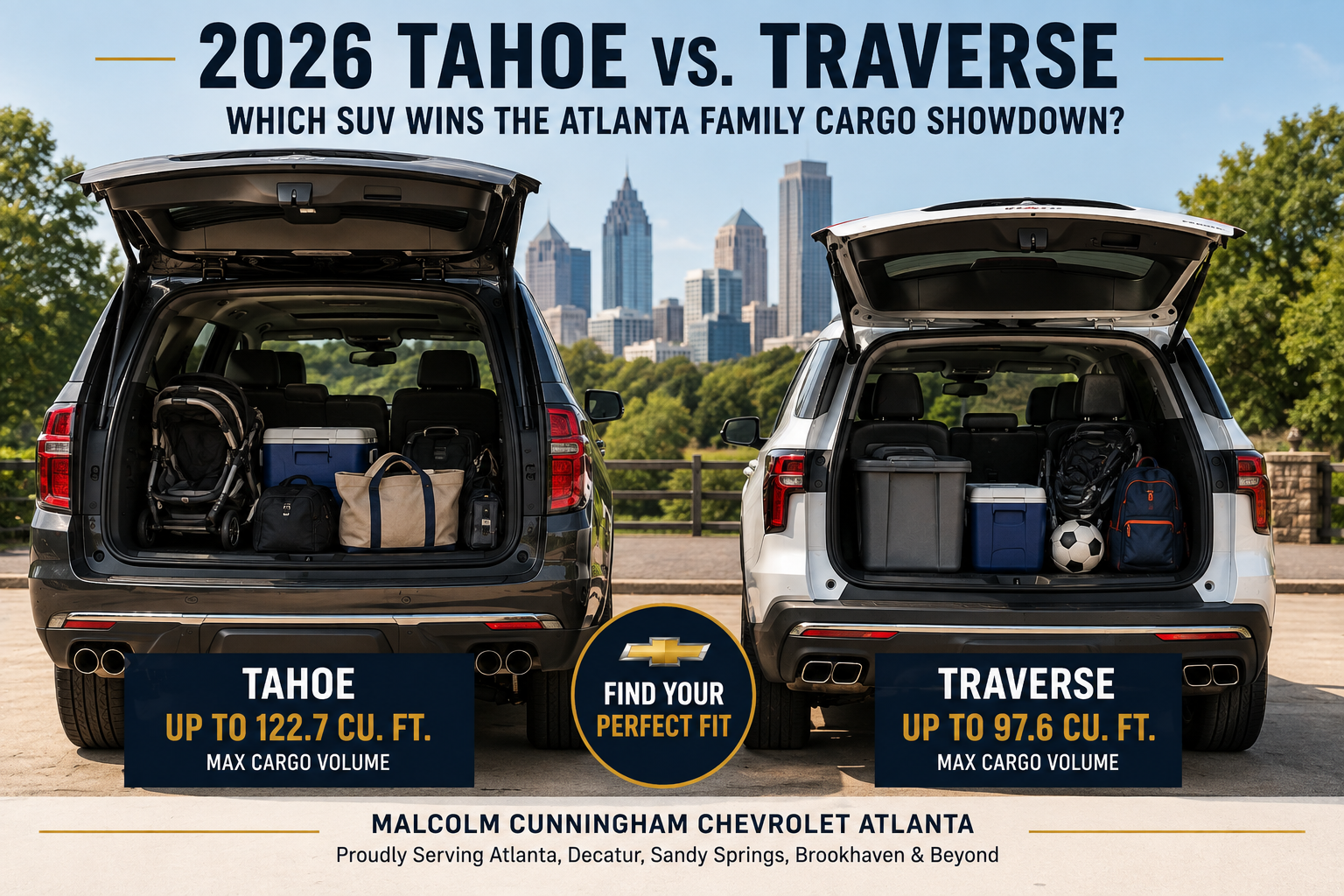
The 2026 Chevrolet Tahoe offers roughly 122.7 cubic feet of maximum cargo volume with its rear seats folded, while the 2026 Chevrolet Traverse provides approximately 97.6 cubic feet in the same configuration 1. Behind the third row with all seats upright, the Tahoe delivers about 25.5 cubic feet versus the Traverse's 22.9 cubic feet 1. For large Atlanta families who regularly load strollers, sports bags, and Costco runs into their SUV, the Tahoe provides a clear advantage in raw volume — but the Traverse closes the gap when you factor in its more compact footprint for Sandy Springs parking decks and Decatur side streets.

Usable cargo space is the real-world volume you can access without folding or rearranging any seats — the everyday trunk area behind your last occupied row. This is different from maximum cargo volume, which represents the total cubic feet available when you fold every rear seat flat. We find that Atlanta families shopping on our lot often fixate on the maximum number, but it's usable cargo space that determines whether your double BOB stroller fits behind the third row without a wrestling match.

One pattern we see repeatedly at our Atlanta dealership: families with three or more kids who keep all three rows occupied daily need every inch of that behind-third-row space, and the Tahoe's approximately 25.5-cubic-foot advantage in that configuration makes a tangible difference. The Traverse's 22.9 cubic feet behind all seats 1 is still workable for most gear, but tighter when bulky items like hockey bags or Pack 'n Plays enter the equation.

2

Seating Configurations Change Everything: How Folding Rows Reshape Your Cargo Math

Those headline cubic-foot numbers only tell part of the story, because the real cargo calculus shifts dramatically the moment you start folding seats — and Atlanta families rarely use just one seating configuration all week. Here's how the two SUVs compare across the configurations that matter most:

Configuration2026 Chevrolet Tahoe2026 Chevrolet Traverse
Behind 3rd Row (all seats up)25.5 cu. ft.22.9 cu. ft. 1
3rd Row Folded72.5 cu. ft.56.6 cu. ft. 1
2nd & 3rd Rows Folded (max)122.7 cu. ft.97.6 cu. ft. 1

The 2026 Chevrolet Traverse cargo volume changes from 22.9 cubic feet behind the third row to approximately 97.6 cubic feet maximum when all rear rows are folded flat 1. The Tahoe's jump is even more dramatic — roughly a 97-cubic-foot swing between all-seats-up and fully-flat configurations. That mid-range “third row folded only” number is the one our sales team in Atlanta calls the Weekend Configuration, because it reflects how most suburban families actually use their SUV on a Piedmont Park Saturday — five passengers up front and middle, with the entire cargo bay open for coolers, blankets, and a wagon.

Weekend Configuration is the cargo volume available when only the third-row seats are folded flat, preserving full second-row seating for passengers. This middle-ground measurement matters more than maximum volume for most families because you're almost never driving around Atlanta with zero rear passengers.

For road trips from Atlanta down I-75 to the Florida coast, the Tahoe's advantage in third-row legroom and the deeper cargo well behind that third row mean passengers and luggage coexist more comfortably. The Traverse, being a crossover-based platform, offers a lower cargo floor that makes loading and unloading heavier items — like camping gear for trips up to North Georgia — noticeably easier on your back.

3

How We Help Atlanta Families Pick the Right Fit at Malcolm Cunningham Chevrolet

Knowing the numbers is one thing — knowing which numbers matter for your family is where our team's experience makes the difference.

💡 Pro Tip: Both the 2026 Tahoe and Traverse offer Chevrolet's AutoSense power liftgate, which opens hands-free when it detects your key fob as you stand behind the vehicle. But the Tahoe's liftgate opens to a higher clearance height, meaning tall items like a folding wagon or a Costco shelving unit can slide in without tilting. Ask our team to demo both liftgates with your specific cargo during your visit.

Our approach goes beyond the trunk. We walk families through the cargo management systems in both vehicles — the Tahoe's available configurable rails and tie-downs versus the Traverse's underfloor storage bins — and help match features to lifestyle. Trade professionals in Brookhaven hauling tool cases need different solutions than a Sandy Springs family of six heading to Lake Lanier every weekend.

Malcolm Cunningham Chevrolet Atlanta maintains a robust on-site inventory of both 2026 Tahoe and Traverse trims, including in-transit units. We also offer trade-in evaluations on the spot for families upgrading from an older SUV, so you can walk in with your current vehicle and leave with a clear picture of your monthly payment on either model.

4

Cargo Space Myths That Trip Up Atlanta SUV Shoppers

After walking hundreds of families through side-by-side comparisons, we've noticed the same misconceptions popping up again and again — and they can steer you toward the wrong SUV if nobody clears them up.

Myth: Maximum cargo volume is the only number that matters when choosing between the Tahoe and Traverse.

Reality: Maximum cargo volume represents total space with every rear seat folded flat — a configuration most families rarely use on a daily basis. Usable cargo space is the volume available behind the last occupied row of seats during typical driving, which for most Atlanta families with three or more passengers means the area behind an upright third row. The Traverse offers 22.9 cubic feet in that everyday scenario 1, while the Tahoe provides a noticeably deeper cargo floor behind its third row. The practical difference shows up when you're loading after-school pickups, not when the SUV is empty.

Myth: The Traverse and Tahoe have identical cargo management systems because they're both Chevrolets.

Reality: The 2026 Chevrolet Tahoe and Traverse feature different cargo management approaches tailored to their respective body-on-frame and unibody architectures. The Tahoe's flat-folding third row creates a nearly level load floor suited for heavy or rigid items, while the Traverse uses a split-folding design optimized for flexible, mixed-use loading. Understanding which system matches your lifestyle is something our Chevrolet specialists discuss during every comparison walk-through.

Another pattern we see: families assume a bigger SUV automatically means worse fuel economy around Atlanta's stop-and-go corridors on I-285 and GA-400. The gas-engine Tahoe is EPA-estimated at 16 to 17 mpg combined versus the Traverse's 21 to 22 mpg combined, but the Tahoe's available 3.0L Duramax diesel narrows that gap substantially, with an EPA-estimated combined figure in the low-to-mid 20s. We always recommend comparing total cost of ownership — not just sticker price — which is why our financing team builds out real monthly scenarios for both models.

5

Looking Ahead: Which 2026 Chevy SUV Fits Your Atlanta Family's Next Chapter?

Now that we've cleared up the most common misconceptions, let's talk about how to turn all of this research into a confident decision. The 2026 Chevrolet Tahoe offers greater maximum cargo volume and a deeper behind-third-row cargo well suited for large families who frequently haul bulky gear, while the 2026 Traverse delivers strong cargo capacity in a more maneuverable footprint ideal for families navigating tighter parking in Midtown, Buckhead, and downtown Atlanta. Choosing between them comes down to how you actually live, not which spec sheet looks more impressive.

Here's what we're advising Atlanta-area families to consider right now:

  • Growing families expecting a third child or regularly carpooling should lean Tahoe — the cargo volume behind a fully occupied third row gives you breathing room that compounds over years of use.
  • Urban-suburban commuters in Sandy Springs or Brookhaven who need a capable family hauler but park in tighter garages may find the Traverse hits the sweet spot between space and maneuverability.
  • Road-trip families driving to Hilton Head, the North Georgia mountains, or Gulf Shores should factor in third-row legroom alongside cargo — the Tahoe's longer wheelbase delivers more comfort for passengers and gear simultaneously.
  • Budget-conscious shoppers should ask our financing team about current 2026 incentives. Malcolm Cunningham Chevrolet Atlanta offers tailored financing and trade-in evaluations that can make either model more accessible than you'd expect.

We keep a strong rotation of in-transit and on-lot 2026 Tahoe and Traverse inventory specifically because Atlanta families are actively cross-shopping these two models. If you're ready to move from research to a real comparison, stop by our lot or give us a call — we'll have both SUVs pulled up and ready for your Weekend Load Test before you finish your coffee.

Conclusion

📌 Key TakeawayWhy It Matters
The 2026 Tahoe offers roughly 25 more cubic feet of maximum cargo than the TraverseFull-size families need that extra room.
The Traverse's 97.6 cu. ft. maximum capacity handles most daily needs efficiently 1Compact footprint suits Atlanta's tighter neighborhoods.
Strollers and coolers don't read brochuresReal-world fit beats spec sheets — load your actual gear before you decide.

The 2026 Tahoe wins the raw cargo war, but the Traverse punches well above its size class for Atlanta families who don't need full-size volume every day. The right choice depends entirely on how you actually use the space — weekend tournament gear is a different equation than a Tuesday Trader Joe's run through Brookhaven. The 2026 Chevrolet Tahoe offers the most versatile cargo solution for large families who frequently haul oversized loads, while the Traverse delivers a compelling balance of space and maneuverability for metro Atlanta driving. Our team will walk you through every seating configuration, run you through current financing options, and connect your trade-in value directly to a 2026 Tahoe or Traverse from our on-site inventory.

Ready for your Weekend Load Test? Compare both SUVs side by side on our lot.

Browse Tahoe & Traverse Inventory

? Frequently Asked Questions

6 questions optimized for rich results.

The 2026 Chevrolet Tahoe offers roughly 25.5 cubic feet behind its third row and approximately 122.7 cubic feet of maximum cargo volume with seats folded, making it the clear winner for large Atlanta families who regularly haul bulky gear. The 2026 Chevrolet Traverse provides 22.9 cubic feet behind the third row and 97.6 cubic feet of maximum cargo capacity, which still handles most daily family needs comfortably 1. The deciding factor for most households comes down to whether they need consistent full-size hauling or prefer a slightly more compact footprint for navigating tighter parking in Decatur, Buckhead, and Sandy Springs.
The 2026 Chevrolet Traverse expands from 22.9 cubic feet behind its third row to 97.6 cubic feet of maximum cargo space when the second and third rows are folded 1. The 2026 Tahoe scales from approximately 25.5 cubic feet behind row three to an estimated 122.7 cubic feet with all rear seats stowed, a gain of roughly 25 additional cubic feet over the Traverse. That difference is roughly equivalent to fitting two extra large checked suitcases, which matters for Georgia beach weekends or hauling sports equipment across the metro.
Our team walks every shopper through a hands-on cargo comparison right on our Atlanta lot, loading strollers, coolers, or whatever gear you bring along so you can see the real-world difference rather than guessing from spec sheets. We pair that with a transparent conversation about budget, typical passenger count, and how often you actually need maximum cargo volume. Malcolm Cunningham Chevrolet Atlanta's educational approach means you leave with the SUV that genuinely fits your family's life instead of the one with the biggest number on paper.
Both the 2026 Tahoe and Traverse offer available AutoSense power liftgates that open hands-free with a kicking motion under the rear bumper, but the Tahoe's larger cargo well accommodates deeper items without requiring the second row to fold. The Traverse features a configurable cargo floor and underfloor storage bin that keeps smaller items from sliding, making it particularly practical for grocery runs around Atlanta. Chevrolet's cargo management philosophy across both models centers on flexible flat-folding seats, but the Tahoe's body-on-frame architecture provides a wider load floor between the wheel wells.
Malcolm Cunningham Chevrolet Atlanta provides complimentary, no-obligation trade-in evaluations for any vehicle, whether you're moving up to a 2026 Tahoe or Traverse. Our team uses current market data and transparent pricing to give you a fair assessment on site at our Atlanta location, and we can apply that value directly toward your new purchase or lease.
Maximum cargo volume measures the total interior space from behind the front seats to the ceiling with all rear rows folded flat — for the 2026 Traverse, that figure is 97.6 cubic feet 1. Usable cargo space, by contrast, refers to the area available in a real loading scenario where seat backs, wheel-well intrusions, and load-floor height limit what you can practically fit. At Malcolm Cunningham Chevrolet Atlanta, we encourage shoppers to bring their actual gear — strollers, sports bags, luggage — because usable space is always the number that determines whether an SUV truly works for your family.

📚 Sources

  1. 1 Edmunds' 2026 Chevrolet Traverse features and specifications list cargo volume behind the third row, behind the second row, and maximum with all rear seats folded. — 2026 Chevrolet Traverse Specs & Features | Edmunds

Recommended Posts

Protecting Your Silverado

Chevrolet Maintenance Tips: Malcolm Cunningham Atlanta's Silverado Guide

@import url('https://fonts.googleapis.com/css2?family=Inter:wght@400;500;600;700;800;900&display=swap');:root { --brand: #b8893a; --brand-strong: #9a6f24; --brand-bright: #d4a546; --brand-tint: #faf3e3; --ink: #15171c; --text: #23262d; --text-light: #545a64; --text-muted: #8a909b; --border: #e4e2dc; --border-light: #f2f0ea; --bg-light: #faf9f6; --bg-code: #f3f2ee; } .mcc-blog * { box-sizing: border-box; margin: 0; padding: 0; } .mcc-blog { font-family: 'Inter', -apple-system, BlinkMacSystemFont, 'Segoe UI', Roboto, sans-serif; color: var(--text); line-height: 1.75; max-width: 800px; margin: 0 auto; padding: 0 2rem 3rem; background: #fff; } .mcc-blog .brand-bar { max-width: 800px; margin: 0 auto 2.5rem; padding: 1.1rem 0 1.1rem; border-bottom: 3px solid var(--brand-bright); display: flex; align-items: center; gap: 0.85rem; } .mcc-blog .brand-bowtie { flex-shrink: 0; width: 2.4rem; height: 2.4rem; background: var(--ink); border-radius: 8px; display: inline-flex; align-items: center; justify-content: center; color: var(--brand-bright); font-weight: 900; font-size: 1rem; letter-spacing: -0.02em; } .mcc-blog .brand-name { font-size: 0.95rem; font-weight: 800; color: var(--ink); line-height: 1.2; letter-spacing: -0.01em; } .mcc-blog .brand-loc { font-size: 0.72rem; font-weight: 600; text-transform: uppercase; letter-spacing: 0.1em; color: var(--brand-strong); } .mcc-blog .meta-header { margin-bottom: 2rem; } .mcc-blog .meta-header h1 { font-size: 2.25rem; font-weight: 900; line-height: 1.18; color: var(--ink); margin-bottom: 0.75rem; letter-spacing: -0.02em; } .mcc-blog .meta-description { font-size: 1rem; color: var(--text-light); font-weight: 450; line-height: 1.6; } .mcc-blog .reading-time { display: flex; align-items: center; gap: 1rem; font-size: 0.875rem; color: var(--text-muted); margin-bottom: 2.5rem; padding-bottom: 1rem; border-bottom: 1px solid var(--border); } .mcc-blog .reading-time .divider { color: var(--border); } .mcc-blog .introduction { font-size: 1.18rem; font-style: italic; color: var(--text-light); font-weight: 500; border-left: 4px solid var(--brand-bright); padding-left: 1.5rem; margin-bottom: 3rem; line-height: 1.8; } .mcc-blog .introduction p { margin-bottom: 1rem; color: var(--text-light); } .mcc-blog .introduction p:last-child { margin-bottom: 0; } .mcc-blog .toc { background: var(--bg-light); border: 1px solid var(--border); border-radius: 12px; padding: 1.5rem 2rem; margin-bottom: 3rem; } .mcc-blog .toc-title { font-size: 0.7rem; font-weight: 700; text-transform: uppercase; letter-spacing: 0.1em; color: var(--brand-strong); margin-bottom: 0.75rem; } .mcc-blog .toc ol { list-style: none; counter-reset: toc-counter; padding: 0; margin: 0; } .mcc-blog .toc li { counter-increment: toc-counter; padding: 0.35rem 0.5rem; border-radius: 8px; } .mcc-blog .toc li:hover { background: var(--brand-tint); } .mcc-blog .toc li::before { content: counter(toc-counter); font-family: 'SF Mono', 'Fira Code', monospace; font-size: 0.7rem; color: var(--brand-strong); margin-right: 0.75rem; display: inline-block; width: 1rem; text-align: right; font-weight: 700; } .mcc-blog .toc a { color: var(--ink); font-weight: 500; text-decoration: none; font-size: 0.9rem; } .mcc-blog .toc a:hover { color: var(--brand-strong); text-decoration: underline; } .mcc-blog .toc .toc-conclusion::before { content: "\2022"; font-size: 0.9rem; } .mcc-blog .section { margin-bottom: 3.5rem; } .mcc-blog .section-header { display: flex; align-items: center; gap: 1rem; margin-bottom: 1.5rem; } .mcc-blog .section-number { flex-shrink: 0; width: 1.9rem; height: 1.9rem; border-radius: 8px; background: var(--ink); color: var(--brand-bright); display: inline-flex; align-items: center; justify-content: center; font-size: 0.8rem; font-weight: 800; } .mcc-blog .section h2 { font-size: 1.7rem; font-weight: 800; line-height: 1.3; color: var(--ink); letter-spacing: -0.01em; } .mcc-blog .section h3 { font-size: 1.15rem; font-weight: 700; color: var(--brand-strong); margin-top: 1.5rem; margin-bottom: 0.75rem; } .mcc-blog p { margin-bottom: 1rem; font-weight: 450; color: var(--text); } .mcc-blog p:last-child { margin-bottom: 0; } .mcc-blog strong { font-weight: 700; color: var(--ink); } .mcc-blog em { font-style: italic; } .mcc-blog .content-link { color: var(--brand-strong); font-weight: 600; text-decoration: underline; text-underline-offset: 2px; } .mcc-blog .content-link:hover { color: var(--ink); } .mcc-blog .table-wrapper { overflow-x: auto; margin: 1.5rem 0; border-radius: 10px; border: 1px solid var(--border); } .mcc-blog table { width: 100%; border-collapse: collapse; font-size: 0.875rem; } .mcc-blog th { background: var(--ink) !important; padding: 0.7rem 1rem; text-align: left; font-weight: 700; color: #fff !important; border-bottom: 2px solid var(--brand-bright) !important; } .mcc-blog td { padding: 0.625rem 1rem; color: var(--text-light); border-bottom: 1px solid var(--border-light); } .mcc-blog tr:last-child td { border-bottom: none; } .mcc-blog tr:nth-child(even) td { background: var(--bg-light); } .mcc-blog blockquote { border-left: 4px solid var(--border); background: var(--bg-light); padding: 0.875rem 1rem 0.875rem 1.25rem; margin: 1.25rem 0; border-radius: 0 8px 8px 0; font-weight: 450; } .mcc-blog blockquote.pro-tip { border-left-color: var(--brand-bright); background: var(--brand-tint); } .mcc-blog ol, .mcc-blog ul { margin: 1.25rem 0; padding-left: 1.75rem; } .mcc-blog li { margin-bottom: 0.5rem; padding-left: 0.25rem; line-height: 1.65; color: var(--text); } .mcc-blog ol li::marker { color: var(--brand-strong); font-weight: 700; } .mcc-blog hr { border: none; border-top: 1px solid var(--border); margin: 2.5rem 0; } .mcc-blog .conclusion { margin-top: 3.5rem; padding-top: 2.5rem; border-top: 1px solid var(--border); } .mcc-blog .conclusion h2 { font-size: 1.5rem; font-weight: 800; margin-bottom: 1.5rem; color: var(--ink); } .mcc-blog .cta-band { margin: 2.5rem 0 0; background: var(--ink); border-radius: 14px; padding: 1.75rem 2rem; display: flex; flex-wrap: wrap; align-items: center; justify-content: space-between; gap: 1rem; } .mcc-blog .cta-band p { color: #fff; font-weight: 600; font-size: 1.05rem; margin: 0; max-width: 28rem; } .mcc-blog .cta-button { flex-shrink: 0; display: inline-block; background: var(--brand-bright); color: var(--ink); font-weight: 800; font-size: 0.9rem; text-decoration: none; padding: 0.8rem 1.5rem; border-radius: 8px; letter-spacing: 0.01em; transition: background 0.15s ease; } .mcc-blog .cta-button:hover { background: #e6b955; } .mcc-blog .faq { margin-top: 3rem; } .mcc-blog .faq > h2 { font-size: 1.5rem; font-weight: 800; margin-bottom: 0.5rem; color: var(--ink); display: flex; align-items: center; gap: 0.75rem; } .mcc-blog .faq-badge { display: inline-flex; align-items: center; justify-content: center; width: 1.85rem; height: 1.85rem; background: var(--ink); color: var(--brand-bright); border-radius: 8px; font-size: 0.95rem; font-weight: 900; } .mcc-blog .faq-count { color: var(--text-light); font-size: 0.875rem; font-weight: 500; margin-bottom: 1.5rem; } .mcc-blog .faq-list { border: 1px solid var(--border); border-radius: 14px; overflow: hidden; } .mcc-blog .faq-item { border-bottom: 1px solid var(--border-light); } .mcc-blog .faq-item:last-child { border-bottom: none; } .mcc-blog .faq-question { width: 100%; display: flex; align-items: flex-start; gap: 0.75rem; background: none; border: none; text-align: left; cursor: pointer; padding: 1.25rem 1.5rem; font-family: inherit; transition: background 0.15s ease; } .mcc-blog .faq-question:hover { background: var(--bg-light); } .mcc-blog .faq-item.open .faq-question { background: var(--brand-tint); } .mcc-blog .faq-q-marker { color: var(--brand-strong); font-weight: 900; font-size: 0.85rem; flex-shrink: 0; margin-top: 0.15rem; } .mcc-blog .faq-q-text { flex: 1; font-weight: 700; font-size: 1rem; line-height: 1.4; color: var(--ink); } .mcc-blog .faq-toggle { flex-shrink: 0; position: relative; width: 1.1rem; height: 1.1rem; margin-top: 0.2rem; } .mcc-blog .faq-toggle::before, .mcc-blog .faq-toggle::after { content: ""; position: absolute; background: var(--brand-strong); border-radius: 2px; transition: transform 0.25s ease, opacity 0.25s ease; } .mcc-blog .faq-toggle::before { top: 50%; left: 0; right: 0; height: 2px; transform: translateY(-50%); } .mcc-blog .faq-toggle::after { left: 50%; top: 0; bottom: 0; width: 2px; transform: translateX(-50%); } .mcc-blog .faq-item.open .faq-toggle::after { transform: translateX(-50%) scaleY(0); opacity: 0; } .mcc-blog .faq-answer-wrap { max-height: 0; overflow: hidden; transition: max-height 0.3s ease; } .mcc-blog .faq-answer { padding: 0 1.5rem 1.5rem 3rem; color: var(--text-light); font-size: 0.92rem; font-weight: 450; line-height: 1.7; } .mcc-blog .sources { margin-top: 3rem; padding-top: 2rem; border-top: 1px solid var(--border); } .mcc-blog .sources h2 { font-size: 1.5rem; font-weight: 800; margin-bottom: 1.25rem; color: var(--ink); } .mcc-blog .sources-list { list-style: none; padding: 0; margin: 0; display: flex; flex-direction: column; gap: 0.75rem; } .mcc-blog .sources-list li { display: flex; gap: 0.75rem; align-items: flex-start; font-size: 0.875rem; color: var(--text-light); line-height: 1.6; } .mcc-blog .source-number { flex-shrink: 0; width: 1.75rem; height: 1.75rem; border-radius: 50%; background: var(--ink); display: inline-flex; align-items: center; justify-content: center; font-weight: 700; font-size: 0.75rem; color: var(--brand-bright); margin-top: 0.1rem; } .mcc-blog .sources-list a { color: var(--brand-strong); text-decoration: none; font-weight: 600; word-break: break-word; } .mcc-blog .sources-list a:hover { text-decoration: underline; } .mcc-blog sup.cite { display: inline-flex; align-items: center; justify-content: center; min-width: 1.1rem; height: 1.1rem; padding: 0 0.25rem; font-size: 0.625rem; font-weight: 700; background: var(--brand-tint); color: var(--brand-strong); border-radius: 999px; margin-left: 0.15rem; position: relative; top: -0.35em; text-decoration: none; } .mcc-blog a sup.cite:hover { background: var(--brand-bright); color: var(--ink); } .mcc-blog .schema { margin-top: 3rem; } .mcc-blog .schema h2 { font-size: 1.5rem; font-weight: 800; margin-bottom: 0.5rem; color: var(--ink); } .mcc-blog .schema-desc { color: var(--text-light); font-size: 0.875rem; margin-bottom: 1rem; font-weight: 450; } .mcc-blog .schema pre { background: var(--bg-code); border: 1px solid var(--border); border-radius: 14px; padding: 1.5rem; overflow-x: auto; font-family: 'SF Mono', 'Fira Code', 'Consolas', monospace; font-size: 0.8rem; line-height: 1.6; max-height: 500px; overflow-y: auto; margin-bottom: 1rem; } .mcc-blog .export-footer { margin-top: 3rem; padding-top: 1.5rem; border-top: 1px solid var(--border); font-size: 0.8rem; color: var(--text-muted); text-align: center; } @media (max-width: 600px) { .mcc-blog { padding: 0 1.25rem 2rem; } .mcc-blog .brand-bar { padding: 0.9rem 0; } .mcc-blog .meta-header h1 { font-size: 1.7rem; } .mcc-blog .introduction { font-size: 1.05rem; padding-left: 1rem; } .mcc-blog .cta-band { flex-direction: column; align-items: flex-start; } .mcc-blog .faq-answer { padding-left: 1.5rem; } } MC Malcolm Cunningham Chevrolet Atlanta Alpharetta · Atlanta · Roswell · Cumming Chevrolet maintenance tips to protect your Silverado's resale value from Georgia's red clay and rain. Malcolm Cunningham Chevrolet Atlanta's expert guide. ⏱ 11 min read | 2,595 words Picture this: you pull your Silverado out of a job site in Decatur after a week of summer thunderstorms, and the rocker panels are caked in that unmistakable Georgia red clay — the kind that doesn't just rinse off but bonds to your truck's finish like a second skin. That iron-oxide-rich soil, combined with Atlanta's relentless humidity and annual rainfall that frequently exceeds 50 inches, creates one of the harshest environments for a truck's exterior, undercarriage, and mechanical components anywhere in the Southeast. If you're planning to trade in or sell your Silverado down the road, every season you skip proactive maintenance is money quietly draining from your resale value. And here's the part most owners miss: the damage from Georgia's climate doesn't announce itself with a check-engine light — it shows up as faded paint, corroded brake hardware, and cabin mold that a future buyer's inspector will absolutely catch. At Malcolm Cunningham Chevrolet Atlanta, our Chevrolet technicians work on Silverados every single day that bear the battle scars of I-285 commutes, gravel-road hunting trips in North Georgia, and summers where the heat index sits above 100°F for weeks at a time. We've built our service approach around understanding exactly how Atlanta's specific climate cycle — the spring pollen storms, the muggy July downpours, the mild but deceptively damp winters — wears on every generation of Silverado from the 1500 to the HD models. Georgia's combination of acidic red clay soil, high humidity, and intense UV exposure makes a region-specific maintenance schedule essential for preserving a Chevrolet Silverado's long-term resale value. In this guide, we're going to walk you through the Chevrolet maintenance tips our service team recommends specifically for Atlanta-area Silverado owners — from undercarriage protection strategies to seasonal fluid checks — so you can keep your truck looking and performing like the day you drove it off our lot in years to come. In This Article Why Georgia's Red Clay Is Your Silverado's Biggest Resale Threat The Three Biggest Maintenance Mistakes Atlanta Silverado Owners Make How Our Chevrolet Certified Service Team Fights Red Clay Damage Year-Round Your Seasonal Silverado Protection Plan: A Step-by-Step Guide for Atlanta's Weather Cycles Three Myths That Quietly Destroy Your Silverado's Value in Georgia's Climate Looking Ahead: Why Proactive Maintenance Is the Smartest Investment for 2026 and Beyond Conclusion 1 Why Georgia's Red Clay Is Your Silverado's Biggest Resale Threat Georgia red clay contains iron oxide concentrations that chemically bond to automotive paint, clear coat, and exposed metal surfaces when left untreated — making it far more damaging than ordinary road grime. Unlike the sandy or loam-based soils found in other parts of the country, the Ultisol clay prevalent from Atlanta's southern suburbs through North Georgia retains moisture for extended periods, creating a sustained corrosive environment on every surface it touches. That combination of mineral content and moisture retention is precisely why we see so many Silverado owners from Decatur, Sandy Springs, and Brookhaven drive into our Service center with undercarriage corrosion they never expected. The short answer Protecting your Silverado's resale value in Georgia requires a three-part approach: frequent undercarriage washes to remove iron-oxide-rich red clay before it bonds to metal, a seasonal paint protection routine that accounts for Atlanta's heavy rainfall and humidity, and adherence to a climate-adjusted service schedule rather than the generic factory intervals. Trucks maintained with this approach in the Atlanta metro area consistently appraise higher at trade-in than those following standard national guidelines. Clay Creep is the gradual, often invisible accumulation of iron-oxide clay deposits in frame rails, brake line brackets, and suspension joints that accelerates corrosion between service intervals. Clay Creep is one of the most underestimated factors in premature resale depreciation for trucks driven regularly in Georgia. Our technicians inspect for it because the damage it causes is cumulative — a Silverado driven on red clay roads near Lake Lanier or along rural routes in North Georgia can develop measurable frame surface corrosion in as little as one wet season if the undercarriage isn't cleaned and treated. Washing a vehicle's undercarriage frequently in red clay regions matters because the iron oxide in the soil creates a micro-abrasive layer that traps moisture against bare metal, accelerating oxidation far faster than road salt damage in northern climates. That's a fact most owners don't learn until trade-in day, when the appraiser puts the truck on a lift. 2 The Three Biggest Maintenance Mistakes Atlanta Silverado Owners Make Understanding that red clay is uniquely destructive is only half the equation — what really erodes your Silverado's value are the well-intentioned habits that actually make things worse. One of the most common mistakes we help truck owners fix at our Atlanta service center is relying on automatic touchless car washes as their sole defense. While touchless washes remove surface mud, they rarely generate enough pressure to flush clay packed into frame crossmembers, leaf spring hangers, or the crevices around differential covers. The result is a truck that looks clean up top but is quietly corroding underneath. Here are the three mistakes we see most frequently among Georgia truck owners: Mistake Why It Seems Right What Actually Happens Using only touchless car washes Convenient, avoids paint scratches Leaves compacted clay in frame rails and brake components; moisture stays trapped against metal Skipping wax or sealant during summer “It's too hot, and rain will wash the truck anyway” Atlanta's UV index and acid rain strip unprotected clear coat; paint oxidation begins within one season Following the standard owner's manual service schedule without adjustment “The manufacturer knows best” Factory intervals assume average conditions; Georgia's humidity, red clay, and frequent rain qualify as severe-duty driving conditions per Chevrolet's own guidelines A Silverado driven primarily in the muddy conditions of North Georgia should follow Chevrolet's severe-duty maintenance schedule, which calls for more frequent oil changes, transmission fluid inspections, and chassis lubrication than the standard intervals printed in the owner's manual. Atlanta's frequent rain and high humidity also accelerate moisture intrusion into brake systems — rotors on full-size pickups in this climate develop surface rust overnight, and brake pad compounds degrade faster when they're constantly cycling between wet and dry conditions. Ignoring that reality is one of the fastest ways to leave money on the table when it's time to trade in. 3 How Our Chevrolet Certified Service Team Fights Red Clay Damage Year-Round Avoiding those common mistakes is straightforward once you have the right service partner guiding your maintenance calendar — and that's exactly the role our team at Malcolm Cunningham Chevrolet Atlanta plays for Silverado owners across the metro area. When choosing a Chevy service center in Georgia to protect a truck from red clay damage, owners should look for three things: Chevrolet master technicians who understand regional driving conditions, access to genuine OEM parts that maintain factory corrosion warranties, and a service department that proactively adjusts maintenance intervals based on local climate data rather than generic national schedules. We check all three boxes, and it's a difference our customers from Brookhaven to the North Georgia foothills notice at trade-in time. Our approach starts with what we call a Seasonal Reset Service, which is a climate-specific inspection and treatment protocol we perform at the transition between Georgia's wet and dry seasons. During a Seasonal Reset, our technicians perform a high-pressure undercarriage flush targeting known Clay Creep accumulation points on the Silverado platform, inspect brake hardware for humidity-driven corrosion, and apply factory-recommended corrosion inhibitors to exposed chassis components. We use genuine OEM Chevrolet parts exclusively because aftermarket brake rotors, suspension bushings, and fluid specifications often lack the protective coatings and tolerances that preserve long-term resale value — a distinction that certified pre-owned inspectors and trade-in appraisers specifically look for. 💡 Pro Tip: Ask your service advisor to document every undercarriage treatment and OEM part installation on your Carfax or service record. When it's time for a trade-in, a verified maintenance history showing climate-specific care consistently results in stronger appraisal values. Our team at Malcolm Cunningham Chevrolet Atlanta can build this documentation into every visit automatically — it's one reason our trade-in customers across the Atlanta metro tend to walk in with trucks that appraise at the top of the market range. If your Silverado has been battling Georgia's clay and rain without a plan, reach out to our service team to schedule a Seasonal Reset — we'll show you exactly where your truck stands and what it needs to hold its value for the long haul. 4 Your Seasonal Silverado Protection Plan: A Step-by-Step Guide for Atlanta's Weather Cycles Beyond what our Certified Service team handles in the bay, there's a practical seasonal routine every Silverado owner in the Atlanta metro can follow at home to protect paint, undercarriage, and long-term trade-in value. Georgia's climate doesn't give your truck a break — spring pollen coats every surface, summer thunderstorms drive red clay into every seam, fall brings leaf tannins that stain clearcoat, and winter's freeze-thaw cycles accelerate any existing corrosion. Here's the seasonal plan our Chevrolet master technicians recommend: The short answer Protecting a Silverado's resale value in Georgia requires frequent undercarriage washes to remove iron-oxide-rich red clay, seasonal wax or ceramic coating to shield paint from UV and acidic rain, brake inspections every six months due to Atlanta's high humidity, and exclusive use of genuine OEM Chevrolet parts for any replacements. A disciplined seasonal routine can preserve thousands of dollars in trade-in value. Every two weeks (year-round): Wash the undercarriage with a pressure washer or touchless wash, paying extra attention to frame rails, cross-members, and the inside of wheel wells. Washing a vehicle's undercarriage frequently in red clay regions is critical because Georgia's iron-oxide soil traps moisture against bare metal and accelerates oxidation far faster than neutral-pH soils. Spring (March–May): Apply a fresh coat of spray wax or have a professional ceramic sealant applied before pollen and storm season peaks. Our parts department stocks Chevrolet-approved paint protection products sized for every Silverado cab configuration. Summer (June–August): Inspect weather stripping, door seals, and bed drain plugs. Atlanta's combination of extreme heat and afternoon downpours can push water past degraded seals and into cab or bed areas. Fall (September–November): Clear leaves and organic debris from cowl vents and bed corners — tannins in decaying leaves are mildly acidic and will etch clearcoat if left sitting. Winter (December–February): Check tire pressures monthly as temperatures swing; inspect brake hardware for surface rust after wet spells. If any step feels beyond your comfort zone, our service advisors at Malcolm Cunningham Chevrolet Atlanta can walk you through it or handle it during a quick appointment — no upsell, just honest guidance. 5 Three Myths That Quietly Destroy Your Silverado's Value in Georgia's Climate Following a solid seasonal routine is half the battle — the other half is avoiding well-intentioned habits that actually accelerate wear in humid, clay-heavy environments like metro Atlanta. We hear the same misconceptions from Silverado owners in Decatur, Sandy Springs, and Brookhaven every week, and correcting them early can save thousands at trade-in time. ❌ Myth: Aftermarket parts perform the same as OEM and won't affect resale value. ✅ Reality: Genuine OEM Chevrolet parts are engineered to the exact tolerances of your Silverado's drivetrain and body. Vehicles serviced exclusively with OEM components typically appraise higher during trade-in evaluations because documentation proves factory-spec maintenance. Our parts counter carries the full catalog of genuine Chevrolet components — filters, brake pads, rotors, and fluids — so you never have to compromise. ❌ Myth: Rain keeps your truck clean enough that you can skip regular washes. ✅ Reality: Atlanta rainfall is mildly acidic, averaging a pH between 4.2 and 4.8, which means every storm deposits a thin acidic film on paint and exposed metal. The most effective maintenance tips for protecting a truck's paint from heavy rain and mud in the South include immediate post-storm rinses and quarterly sealant applications — not relying on rain itself. ❌ Myth: Brake inspections are only necessary once a year. ✅ Reality: Frequent rain and high humidity in Atlanta accelerate surface corrosion on brake rotors and caliper hardware of full-size pickups. Moisture-related brake corrosion can reduce rotor life and compromise braking performance if left unchecked between standard service intervals. Our technicians recommend a visual brake inspection every six months for any Silverado driven regularly in Georgia's wet conditions. When choosing a Chevy service center in Georgia to protect a truck from red clay damage, owners should look for Chevrolet-certified master technicians, on-site OEM parts inventory, and documented experience with the region's specific soil and climate challenges — all of which define our service department at Malcolm Cunningham Chevrolet Atlanta. 6 Looking Ahead: Why Proactive Maintenance Is the Smartest Investment for Atlanta Silverado Owners in 2026 and Beyond Now that you know which myths to dodge, let's talk about where the market is headed — because protecting resale value isn't just about today's clay and rain; it's about positioning your Silverado for the strongest possible return when you're ready to trade up. The recommended service schedule for a Silverado driven primarily in the muddy conditions of North Georgia should follow Chevrolet's “Severe Duty” maintenance intervals rather than the standard schedule, since off-pavement exposure and persistent clay contact qualify as severe operating conditions under GM's guidelines. Here's what we see shaping Silverado resale value in the Atlanta market through 2026 and into 2027: Documented service history is becoming non-negotiable. Buyers and appraisal tools used by dealerships increasingly weigh verifiable maintenance records. Every service visit at Malcolm Cunningham Chevrolet Atlanta is logged digitally, giving your truck a transparent ownership story that strengthens trade-in offers. EV and hybrid truck options are expanding, driving trade-in activity. As models like the Silverado EV gain traction, owners of current-generation gas and diesel Silverados who've maintained their trucks meticulously will command premium trade-in values during the transition window. Undercarriage rust prevention is trending toward factory-applied and dealer-applied protective films. Our service team stays current on GM's latest corrosion-protection bulletins so we can recommend treatments backed by engineering data, not marketing hype. Malcolm Cunningham Chevrolet Atlanta offers some of the strongest trade-in valuations for well-maintained Silverados in the metro area because our appraisal process accounts for documented preventive care — the exact kind of care this guide walks you through. If you're ready to see what your Silverado is worth or want to lock in a maintenance plan that protects its value for years, give our team a call or stop by — we're your neighbors, and we'd rather help you keep your truck in top shape than see Georgia's red clay win. Conclusion 📌 Key Takeaway Why It Matters Georgia's red clay traps moisture against metal and accelerates undercarriage corrosion far beyond normal road conditions Unchecked corrosion silently destroys resale value. Following Chevrolet's severe-duty maintenance schedule — not the standard one — is essential for Silverados driven on Atlanta-area clay and dirt roads Shorter service intervals protect drivetrain and frame integrity. Consistent use of genuine OEM parts and documented service history are the two strongest levers for maximizing trade-in offers Appraisers reward verifiable, factory-spec maintenance records. Protecting your Silverado's resale value in Georgia comes down to three non-negotiable habits: frequent undercarriage care, adherence to the severe-duty service schedule, and a documented history of OEM-quality maintenance. Silverado owners in the Atlanta metro area who follow these Chevrolet maintenance tips consistently could retain significantly more value at trade-in than those who follow only the standard owner's manual intervals. Proactive, climate-aware maintenance is the most cost-effective investment any Georgia truck owner can make. Our Chevrolet Certified Service team at Malcolm Cunningham Chevrolet Atlanta is ready to build a personalized seasonal maintenance plan for your Silverado — one that accounts for the specific red-clay, humidity, and heavy-rain conditions you drive through every week. Schedule a service appointment online or call our Alpharetta, GA service center to get your truck on a protection plan that pays for itself when trade-in time arrives. Put your Silverado on a climate-smart protection plan before the next storm season. Schedule a Service Appointment? Frequently Asked Questions 6 questions optimized for rich results. Q. How does Georgia's red clay affect the undercarriage of a Chevrolet Silverado over time? Georgia's red clay contains iron oxide and fine mineral particles that pack into undercarriage crevices, trap moisture against bare metal, and accelerate oxidation far faster than typical road grime. Over months and years, this persistent moisture-and-mineral contact corrodes brake lines, exhaust components, frame crossmembers, and suspension hardware — components that appraisers inspect closely during trade-in evaluation. Regular undercarriage flushing, ideally every two to four weeks during Georgia's wet season, is the single most effective way to slow this process and protect long-term resale value. Q. What does Malcolm Cunningham Chevrolet Atlanta's service team do differently to protect Silverados from red clay damage? Malcolm Cunningham Chevrolet Atlanta employs Chevrolet master technicians who perform targeted undercarriage inspections as part of every routine service visit, specifically checking for red-clay buildup in drain channels, brake dust shields, and frame rail pockets that most general shops overlook. Our Certified Service center uses factory-spec cleaning procedures and genuine OEM protective coatings designed for the Silverado's specific frame geometry. This localized, model-specific expertise means issues like trapped-moisture corrosion are caught and addressed before they become costly repairs that tank resale value. Q. What are common mistakes truck owners make when trying to maintain resale value in humid climates like Georgia? The three most damaging mistakes are skipping undercarriage washes after off-road or dirt-road driving, using aftermarket replacement parts that appraisers flag as value-reducers, and neglecting cabin air filter and HVAC maintenance in high-humidity months, which leads to persistent mildew odor that is extremely difficult to remove. Many Silverado owners also follow the standard maintenance schedule printed in the owner's manual rather than the severe-duty schedule, which Chevrolet actually recommends for vehicles regularly exposed to dusty or muddy conditions. Adopting the severe-duty interval — with shorter oil change and filter replacement cycles — preserves drivetrain integrity and keeps documented service history robust for resale. Q. What is the recommended service schedule for a Silverado driven primarily in the muddy conditions of North Georgia? Chevrolet classifies frequent exposure to dusty or muddy roads as a severe-duty operating condition, which shortens recommended oil and filter change intervals to roughly every 3,000–5,000 miles or every three months, whichever comes first. Brake inspections, tire rotations, and transmission fluid checks should follow the same accelerated timeline, and undercarriage flushes should occur at minimum monthly during Georgia's spring and winter wet seasons. At Malcolm Cunningham Chevrolet Atlanta, our technicians can build a maintenance calendar based on each customer's actual driving patterns across metro Atlanta and the North Georgia foothills. Q. What are the benefits of using genuine OEM Chevrolet parts versus aftermarket parts for long-term resale value? Genuine OEM Chevrolet parts are engineered to the exact tolerances and material specifications of each Silverado generation, ensuring proper fit, optimal performance, and full compatibility with onboard diagnostic systems. Aftermarket parts may carry lower upfront costs but often introduce fitment issues, faster wear rates, and gaps in warranty coverage that sophisticated buyers and dealership appraisers will identify during trade-in evaluation. A documented service history showing consistent OEM part usage is one of the strongest signals of a well-maintained truck, and it directly supports higher resale and trade-in offers. Q. Why do Atlanta-area Silverado owners choose Malcolm Cunningham Chevrolet Atlanta for long-term vehicle care? Malcolm Cunningham Chevrolet Atlanta combines a deep on-site inventory of genuine Chevrolet OEM parts with Chevrolet master technicians who specialize in the Silverado platform, so every service visit addresses the model-specific wear patterns created by Atlanta's heat, humidity, and red-clay terrain. The dealership's transparent, educational approach means customers leave each appointment understanding exactly what was done and why, building a comprehensive service record that maximizes trade-in value down the road. Residents from Decatur, Sandy Springs, Brookhaven, and across the metro area rely on this combination of specialized expertise and community-focused service. (function() { var items = document.querySelectorAll('.mcc-blog .faq-item'); items.forEach(function(item) { var btn = item.querySelector('.faq-question'); var wrap = item.querySelector('.faq-answer-wrap'); btn.addEventListener('click', function() { if (item.classList.contains('open')) { wrap.style.maxHeight = wrap.scrollHeight + 'px'; requestAnimationFrame(function() { wrap.style.maxHeight = '0px'; }); item.classList.remove('open'); btn.setAttribute('aria-expanded', 'false'); } else { item.classList.add('open'); btn.setAttribute('aria-expanded', 'true'); wrap.style.maxHeight = wrap.scrollHeight + 'px'; wrap.addEventListener('transitionend', function te() { if (item.classList.contains('open')) { wrap.style.maxHeight = 'none'; } wrap.removeEventListener('transitionend', te); }); } }); }); })(); Structured data (JSON-LD) — invisible to readers, read by search engines { "@context": "https://schema.org", "@type": "BlogPosting", "headline": "Chevrolet Maintenance Tips: Malcolm Cunningham Atlanta's Silverado Guide", "author": { "@type": "Organization", "name": "Malcolm Cunningham Chevrolet Atlanta", "url": "https://www.malcolmcunninghamchevroletatlanta.com/" }, "publisher": { "@type": "Organization", "name": "Malcolm Cunningham Chevrolet Atlanta", "url": "https://www.malcolmcunninghamchevroletatlanta.com/" }, "mainEntityOfPage": { "@type": "WebPage" }, "description": "Chevrolet maintenance tips to protect your Silverado's resale value from Georgia's red clay and rain. Malcolm Cunningham Chevrolet Atlanta's expert guide.", "datePublished": "2026-08-06T16:23:07.116Z", "dateModified": "2026-08-06T16:26:10.516Z", "wordCount": 2595, "keywords": "Chevrolet maintenance tips, Silverado, Traverse, Tahoe" } { "@context": "https://schema.org", "@type": "FAQPage", "mainEntity": [ { "@type": "Question", "name": "How does Georgia's red clay affect the undercarriage of a Chevrolet Silverado over time?", "acceptedAnswer": { "@type": "Answer", "text": "Georgia's red clay contains iron oxide and fine mineral particles that pack into undercarriage crevices, trap moisture against bare metal, and accelerate oxidation far faster than typical road grime. Over months and years, this persistent moisture-and-mineral contact corrodes brake lines, exhaust components, frame crossmembers, and suspension hardware — components that appraisers inspect closely during trade-in evaluation. Regular undercarriage flushing, ideally every two to four weeks during Georgia's wet season, is the single most effective way to slow this process and protect long-term resale value." } }, { "@type": "Question", "name": "What does Malcolm Cunningham Chevrolet Atlanta's service team do differently to protect Silverados from red clay damage?", "acceptedAnswer": { "@type": "Answer", "text": "Malcolm Cunningham Chevrolet Atlanta employs Chevrolet master technicians who perform targeted undercarriage inspections as part of every routine service visit, specifically checking for red-clay buildup in drain channels, brake dust shields, and frame rail pockets that most general shops overlook. Our Certified Service center uses factory-spec cleaning procedures and genuine OEM protective coatings designed for the Silverado's specific frame geometry. This localized, model-specific expertise means issues like trapped-moisture corrosion are caught and addressed before they become costly repairs that tank resale value." } }, { "@type": "Question", "name": "What are common mistakes truck owners make when trying to maintain resale value in humid climates like Georgia?", "acceptedAnswer": { "@type": "Answer", "text": "The three most damaging mistakes are skipping undercarriage washes after off-road or dirt-road driving, using aftermarket replacement parts that appraisers flag as value-reducers, and neglecting cabin air filter and HVAC maintenance in high-humidity months, which leads to persistent mildew odor that is extremely difficult to remove. Many Silverado owners also follow the standard maintenance schedule printed in the owner's manual rather than the severe-duty schedule, which Chevrolet actually recommends for vehicles regularly exposed to dusty or muddy conditions. Adopting the severe-duty interval — with shorter oil change and filter replacement cycles — preserves drivetrain integrity and keeps documented service history robust for resale." } }, { "@type": "Question", "name": "What is the recommended service schedule for a Silverado driven primarily in the muddy conditions of North Georgia?", "acceptedAnswer": { "@type": "Answer", "text": "Chevrolet classifies frequent exposure to dusty or muddy roads as a severe-duty operating condition, which shortens recommended oil and filter change intervals to roughly every 3,000–5,000 miles or every three months, whichever comes first. Brake inspections, tire rotations, and transmission fluid checks should follow the same accelerated timeline, and undercarriage flushes should occur at minimum monthly during Georgia's spring and winter wet seasons. At Malcolm Cunningham Chevrolet Atlanta, our technicians can build a maintenance calendar based on each customer's actual driving patterns across metro Atlanta and the North Georgia foothills." } }, { "@type": "Question", "name": "What are the benefits of using genuine OEM Chevrolet parts versus aftermarket parts for long-term resale value?", "acceptedAnswer": { "@type": "Answer", "text": "Genuine OEM Chevrolet parts are engineered to the exact tolerances and material specifications of each Silverado generation, ensuring proper fit, optimal performance, and full compatibility with onboard diagnostic systems. Aftermarket parts may carry lower upfront costs but often introduce fitment issues, faster wear rates, and gaps in warranty coverage that sophisticated buyers and dealership appraisers will identify during trade-in evaluation. A documented service history showing consistent OEM part usage is one of the strongest signals of a well-maintained truck, and it directly supports higher resale and trade-in offers." } }, { "@type": "Question", "name": "Why do Atlanta-area Silverado owners choose Malcolm Cunningham Chevrolet Atlanta for long-term vehicle care?", "acceptedAnswer": { "@type": "Answer", "text": "Malcolm Cunningham Chevrolet Atlanta combines a deep on-site inventory of genuine Chevrolet OEM parts with Chevrolet master technicians who specialize in the Silverado platform, so every service visit addresses the model-specific wear patterns created by Atlanta's heat, humidity, and red-clay terrain. The dealership's transparent, educational approach means customers leave each appointment understanding exactly what was done and why, building a comprehensive service record that maximizes trade-in value down the road. Residents from Decatur, Sandy Springs, Brookhaven, and across the metro area rely on this combination of specialized expertise and community-focused service." } } ] } { "@context": "https://schema.org", "@type": "AutoDealer", "name": "Malcolm Cunningham Chevrolet Atlanta", "url": "https://www.malcolmcunninghamchevroletatlanta.com/", "description": "Automotive", "address": { "@type": "PostalAddress", "addressLocality": "atlanta", "addressRegion": "GA", "addressCountry": "US" } }

Silver 2026 Chevy Silverado towing a camper through North Georgia mountain terrain at golden hour.

2026 Chevy Silverado Towing Capacity Guide for Georgia Terrain

Explore 2026 Silverado towing capacity specs tailored for Georgia terrain. Malcolm Cunningham Chevrolet Atlanta breaks down every engine, package & local scenario. Malcolm Cunningham Chevrolet — 2026 Silverado Towing Guide. Paste this entire block into ONE WordPress 'Custom HTML' block. Reading Time ⏱ 12 min read | 2,585 words Introduction Picture this: you're hauling a loaded boat trailer up GA-400 toward Lake Lanier on a Saturday morning, climbing nearly 1,500 feet in elevation through the North Georgia foothills, and your truck starts to strain. That scenario is exactly why understanding the 2026 Silverado towing capacity matters before you ever hook up a trailer — not just the headline number, but how each engine and package performs on the roads you actually drive. The 2026 Chevy Silverado 1500 delivers a maximum conventional towing capacity of 13,300 pounds when properly equipped 1, but that peak rating requires the right powertrain, the Max Trailering Package, and the correct cab and bed configuration 1. For the contractors rolling out of Decatur with equipment trailers and the families in Stone Mountain loading up campers for a weekend at Vogel State Park, knowing which setup matches your real-world load isn't optional — it's the difference between a confident tow and a white-knuckle drive. At Malcolm Cunningham Chevrolet Atlanta, we walk customers through these exact towing decisions every week from our lot near the I-285 perimeter, where we maintain one of the area's strongest inventories of Silverado models across every trim and engine option. Malcolm Cunningham Chevrolet Atlanta is an Atlanta-based Chevrolet dealership specializing in Silverado truck sales, towing configuration, and commercial vehicle outfitting for Greater Atlanta and DeKalb County customers. Our truck specialists don't just hand you a spec sheet — we match your specific trailer weight, your typical routes through Georgia terrain, and your driving habits to the right engine, axle ratio, and trailering package so nothing is left to guesswork. In this guide, we'll break down every 2026 Silverado 1500 engine's towing rating, compare the Max Trailering Package against standard setups, walk through real Georgia towing scenarios from the Blue Ridge Mountains to the coastal flats near Savannah, and give you a downloadable towing cheat sheet you can keep in your glovebox. Table of Contents In This Article 2026 Silverado Towing Capacity: What Every Atlanta Driver Needs to Know Choosing the Right Engine and Package: 2026 Silverado Towing Capacity by Configuration How We Help Atlanta Buyers Match the Right Silverado to Georgia Terrain Your Pre-Tow Checklist: Setting Up the 2026 Silverado Before Hitting Georgia Roads Common Towing Mistakes and Misconceptions We See in Greater Atlanta Looking Ahead: Towing Trends and Smart Silverado Buying Strategy for 2026 and Beyond Conclusion Main Content Sections 1 2026 Silverado Towing Capacity: What Every Atlanta Driver Needs to Know The 2026 Chevy Silverado 1500 has a maximum conventional towing capacity of 13,300 pounds when properly equipped 1. That number matters, but it only tells part of the story—especially for drivers in Greater Atlanta who face terrain that ranges from flat coastal highways to steep mountain grades within a two-hour drive. Understanding how engine choice, drivetrain, and factory packages interact with Georgia's geography is the difference between a confident tow and a white-knuckle haul. The short answer The 2026 Silverado 1500 tows between 8,900 and 13,300 pounds depending on engine, drivetrain, and package configuration 1. To reach the 13,300-pound maximum, the truck must be equipped with the 3.0L Duramax Turbo-Diesel I6, the Max Trailering Package, and the correct cab and bed setup 1. For heavier commercial loads in Georgia, the 2026 Silverado 2500 HD tows up to 22,420 pounds with the 6.6L Duramax Turbo-Diesel V8 1. Properly equipped towing capacity is the maximum weight a specific Silverado configuration can safely tow when it includes the factory-designated engine, axle ratio, hitch receiver, and trailering package for that rating. We stress this distinction at our dealership because one of the most common misunderstandings we encounter is assuming that every Silverado on the lot automatically delivers the headline tow number. Chevrolet instructs 2026 Silverado 1500 owners to check the Trailering Information Label on the driver-side door jamb, which lists GVWR, GCWR, max payload, max tongue weight, and curb weight for that specific truck 1. Our sales team walks every buyer through that label before they leave the lot, because matching your truck to your actual trailer weight is the single most important safety step. 2 Choosing the Right Engine and Package: 2026 Silverado Towing Capacity by Configuration Knowing the 13,300-pound ceiling is useful, but most Atlanta-area buyers need to match a specific engine to a specific job—and that's where configuration choices get real. Whether you're a DeKalb County contractor hauling a skid steer or a family towing a pontoon to Lake Lanier, the powertrain you choose dictates what you can safely pull through the North Georgia foothills. Engine Drivetrain Max Conventional Towing Best Suited For 2.7L TurboMax I4 RWD 9,500 lbs 1 Small boats, utility trailers, landscaping rigs 2.7L TurboMax I4 4WD 9,300 lbs 1 Light loads on varied terrain 5.3L EcoTec3 V8 RWD 11,300 lbs 1 Mid-size campers, enclosed work trailers 5.3L EcoTec3 V8 4WD 11,100 lbs 1 Campers and horse trailers on mountain routes 6.2L EcoTec3 V8 4WD 13,200 lbs 1 Large RVs, heavy dual-axle trailers 3.0L Duramax Diesel I6 Properly Equipped 13,300 lbs 1 Maximum-capacity loads, frequent mountain towing ZR2 Off-Road 4WD ~8,800–8,900 lbs 1 Off-road priority, lighter towing The 3.0L Duramax Turbo-Diesel I6 produces approximately 305 horsepower and 495 lb-ft of torque, which is the key reason it holds the top towing rating and appeals to truck owners who regularly tow in hilly regions 1. For families in the suburbs asking whether to choose the Silverado 1500 or step up to the 2500 HD for horse trailer duty through North Georgia's mountain passes, we recommend a straightforward rule: if your loaded horse trailer consistently exceeds 10,000 pounds, the 2500 HD's 22,420-pound capacity provides a substantial safety margin that the 1500 simply cannot match on steep grades like those along GA-515 toward Blue Ridge. 3 How We Help Atlanta Buyers Match the Right Silverado to Georgia Terrain Selecting the right configuration on paper is one thing—validating it against the roads you'll actually drive is another entirely. At Malcolm Cunningham Chevrolet Atlanta, our truck specialists conduct a one-on-one consultation where we map your specific trailer weights, typical routes, and driving frequency to the correct Silverado engine, drivetrain, and trailering package before you ever sign paperwork. A pre-purchase consultation matches a buyer's trailer weight, route profile, and towing frequency to the optimal Silverado powertrain and factory equipment. In our experience working with contractors near Lithonia and Snellville, the Max Trailering Package is frequently the deciding factor between adequate and confident towing. To reach the 13,300-lb max towing capacity on a 2026 Silverado 1500, the truck must be properly equipped with either the 3.0L Duramax Turbo-Diesel I6 plus the Max Trailering Package and the correct cab/bed configuration 1. For buyers who primarily tow lighter loads around Atlanta's suburbs, the standard trailering setup on the 2.7L TurboMax often handles the job—but anyone planning regular trips through North Georgia's elevation changes or hauling equipment above 9,000 pounds should seriously consider the upgrade. 💡 Pro Tip: Before visiting us, check your trailer's actual loaded weight at a certified scale (there are public truck scales along I-20 east of Atlanta). Most buyers overestimate or underestimate by hundreds of pounds, and that gap directly affects which engine and package we recommend. High humidity and elevation changes across the Georgia Piedmont increase engine heat and reduce air density, both of which can affect towing performance. Our Service department sees this firsthand every summer—Silverados that tow frequently in hot Atlanta conditions benefit from proactive transmission fluid checks and cooling system inspections. If you're shopping for a 2026 Silverado and want help matching it to your specific trailer and routes, schedule an Assessment with our truck team near the I-285 perimeter. We'll walk through every number on that door-jamb label so there are zero surprises on the road. 4 Your Pre-Tow Checklist: Setting Up the 2026 Silverado Before Hitting Georgia Roads Once you've matched the right Silverado configuration to your needs, the next step is making sure everything is set up correctly before every tow. Proper tow setup on a 2026 Chevy Silverado involves verifying the Trailering Information Label, configuring the integrated trailer brake controller, and activating the In-Vehicle Trailering App—steps that take less than ten minutes but can prevent costly mistakes on Georgia's varied terrain. Here's the process our team walks every buyer through during delivery: Check your Trailering Information Label. Chevrolet places this label on the driver-side door jamb, listing your specific truck's GVWR, GCWR, rear GAWR, max payload, max tongue weight, and curb weight 1. These numbers are unique to your build—not a generic spec sheet—so they're your ground truth. Set trailer brake controller gain for your route. For relatively flat suburban driving around Decatur or Stone Mountain, a moderate gain setting works well. When navigating steep descents through the Blue Ridge Mountains on GA-515 or US-19, increase the gain incrementally until braking feels balanced between the truck and trailer. Over-applying trailer brakes causes tire lock-up; under-applying them overloads your Silverado's own braking system. Activate the Trailering App on the infotainment screen. This Chevrolet-exclusive system provides tire pressure monitoring for the trailer, pre-departure checklists, and trailer light diagnostics—all from the cab. Verify tongue weight. Our service advisors recommend targeting roughly 10–15% of total trailer weight as tongue weight, a widely accepted industry standard that prevents trailer sway on I-285 interchange curves and mountain switchbacks alike. If you'd rather have a trained technician walk through this with your specific trailer, our service team at Malcolm Cunningham Chevrolet Atlanta can help—just call ahead and bring your trailer. 5 Common Towing Mistakes and Misconceptions We See in Greater Atlanta Even experienced towers make avoidable errors, and in our years serving DeKalb County contractors and Lake Lanier boaters, certain patterns repeat themselves. ❌ Myth: “The 2.7L TurboMax can handle anything a V8 can—it just has a turbo instead of displacement.” ✅ Reality: The 2026 Silverado's 2.7L TurboMax engine is rated to tow up to 9,500 lbs in RWD or 9,300 lbs in 4WD 1. That's excellent for utility trailers, landscaping rigs, and smaller bass boats headed to Lake Lanier. But a two-horse trailer with living quarters, which commonly weighs between 9,000 and 12,000 lbs loaded, pushes past the TurboMax ceiling. For horse trailers through the North Georgia mountains, the 5.3L V8 at up to 11,300 lbs 1 provides a safer margin—and the 2026 Silverado 2500 HD, rated up to 22,420 lbs with the 6.6L Duramax Turbo-Diesel V8 1, is the better choice when loaded trailer weight consistently exceeds 10,000 lbs on steep grades. Another misconception we encounter: Georgia's heat and humidity don't affect towing performance. They absolutely do. High ambient temperatures in the Georgia Piedmont reduce engine cooling efficiency and increase transmission fluid temperatures, particularly during sustained pulls up elevation. The Piedmont region sits roughly 800 to 1,200 feet above sea level, and summer heat indexes regularly surpass 105°F. Silverado models equipped with the Max Trailering Package include an auxiliary transmission oil cooler specifically designed to manage these thermal loads. Regular transmission maintenance is critical for Silverados that frequently tow heavy loads in hot Atlanta summers. Our Service department recommends shortened transmission fluid intervals for trucks that tow more than twice a month—a schedule we customize based on your actual usage rather than a generic owner's manual timeline. 6 Looking Ahead: Towing Trends and Smart Silverado Buying Strategy for 2026 and Beyond Now that you understand the pitfalls, let's talk about where towing is headed—and how to make a purchasing decision that holds up for years. The 2026 Silverado lineup reflects several shifts that Atlanta-area buyers should factor into their next truck purchase. The short answer: The maximum towing capacity of the 2026 Chevy Silverado 1500 is 13,300 pounds when properly equipped with the 3.0L Duramax Turbo-Diesel I6 plus the Max Trailering Package 1. For commercial fleet use in Georgia, heavy-duty Silverado models exceed 35,500 lbs with the available Max Trailering Package 1, and the Silverado 2500 HD reaches 22,420 lbs. Here's what we're advising our customers in Lithonia, Snellville, and across the I-285 perimeter right now: The Max Trailering Package pays for itself in Georgia. Even for suburban Atlanta drivers who tow occasionally, the auxiliary coolers, enhanced hitch platform, and integrated brake controller included in this package reduce wear on your drivetrain in our climate. Upgrading to the Max Trailering Package on a 2026 Silverado is worth it for anyone towing more than a few weekends per year through North Georgia terrain. Fleet buyers should spec for sustained load, not peak rating. Across Chevrolet's 2026 truck lineup, towing capacities range from about 7,700 lbs for the Colorado to over 36,000 lbs for heavy-duty Silverado models 1. Our dedicated vehicle department helps Georgia fleet operators right-size across that spectrum. Ask before you buy. Before choosing a 2026 Silverado at Malcolm Cunningham Chevrolet Atlanta, ask our team about your specific trailer weight, your most common routes, and whether your payload needs compete with your towing needs—we'll pull the exact build that fits. Stop by our dealership near I-285 in East Atlanta or explore our current Silverado inventory online to find the configuration that matches your Georgia towing life. Conclusion Conclusion 📌 Key Takeaway Why It Matters The 2026 Silverado 1500 tows up to 13,300 lbs with the right engine and Max Trailering Package 1 Reaching peak capacity requires intentional configuration—not every Silverado on a lot is built the same. Engine choice dramatically affects towing range, from 9,500 lbs (2.7L TurboMax) to 13,300 lbs (Duramax diesel) 1 Atlanta buyers hauling boats, campers, or work trailers need to match engine output to their real-world load. Georgia terrain—from Piedmont hills to Blue Ridge mountain grades—demands proper cooling, brake calibration, and transmission maintenance Heat and elevation reduce effective towing performance; factory packages and service schedules compensate for that. The Trailering Information Label on the driver-side door jamb is the definitive source for your specific truck's capacity 1 Published maximums are configuration-dependent; the label confirms exactly what your VIN can handle. Heavy-duty Silverado 2500 HD models extend the ceiling to 22,420 lbs for commercial and large-trailer needs 1 Contractors, fleet operators, and horse trailer owners in North Georgia may need to step up from the 1500 platform. The 2026 Chevy Silverado lineup gives Atlanta-area drivers a towing solution for virtually every scenario—from pulling a bass boat to Lake Lanier on a Saturday morning to running a fleet of work trailers across DeKalb County job sites during the week. The key insight we emphasize to every customer is that maximum towing capacity is not a single number but a product of engine, drivetrain, cab and bed configuration, and factory package selection. The 2026 Chevrolet Silverado 1500 offers a maximum conventional towing capacity of 13,300 pounds when properly equipped with the Duramax diesel or 6.2L V8 and the Max Trailering Package, while the Silverado 2500 HD extends capability to 22,420 pounds for heavier demands. Georgia's combination of summer heat, I-285 congestion, and mountain-grade terrain makes those configuration decisions—and the maintenance that follows—more consequential than in flatter, cooler climates. At Malcolm Cunningham Chevrolet Atlanta, our Silverado specialists sit down with you, review your trailer specs, calculate your real-world tongue and gross combined weights, and walk the lot to find the exact configuration that fits your life in Georgia. Whether you're a Decatur family shopping for a tow-capable weekend truck or a contractor in Lithonia who needs a properly specced work rig, we carry one of the area's strongest Silverado inventories. Stop by our dealership near the I-285 perimeter, give our truck team a call, or use our website to explore current 2026 Silverado inventory and schedule a towing consultation. We'll make sure you leave with the right truck, the right package, and a clear understanding of what your Silverado can do on every road Georgia throws at it. Ready to match a 2026 Silverado to your Georgia towing needs? Explore 2026 Silverado Inventory FAQ? Frequently Asked Questions 8 questions optimized for rich results. Q. What is the maximum towing capacity of the 2026 Chevy Silverado 1500? The 2026 Chevy Silverado 1500 has a maximum conventional towing capacity of 13,300 pounds when properly equipped 1. Reaching that peak rating requires the 3.0L Duramax Turbo-Diesel I6 and the Max Trailering Package, and the correct cab and bed configuration 1. The 5.3L EcoTec3 V8 offers up to 11,300 lbs in rear-wheel drive 1, while the 2.7L TurboMax tops out at 9,500 lbs in RWD 1. Q. Is the 2026 Silverado 1500 or 2500 better for towing a horse trailer through the North Georgia mountains? The right choice depends on your loaded trailer weight and how often you tackle sustained grades. The 2026 Silverado 1500 maxes out at 13,300 lbs when properly equipped 1, which covers many two-horse bumper-pull trailers, but a loaded three- or four-horse gooseneck trailer with living quarters can easily exceed that threshold. The 2026 Silverado 2500 HD, which tows up to 22,420 lbs with the 6.6L Duramax Turbo-Diesel V8 1, provides a significantly larger safety margin for steep climbs along GA-515 or US-19 toward Dahlonega and Blue Ridge. Our team at Malcolm Cunningham Chevrolet Atlanta regularly walks buyers through a weight-and-terrain analysis before recommending a half-ton or heavy-duty platform. Q. Is it worth upgrading to the Max Trailering Package on a 2026 Silverado if I mostly drive in the Atlanta suburbs and North Georgia? The Max Trailering Package is the single most impactful factory option for any Silverado buyer who tows regularly. Without it, the 2026 Silverado 1500's maximum tow rating drops well below the 13,300-lb peak the package enables 1. For Atlanta-area drivers who haul boats to Lake Lanier, pull campers up to North Georgia campgrounds, or tow equipment around DeKalb County job sites, the package delivers a higher-capacity hitch platform, enhanced cooling, and an integrated trailer brake controller that makes steep grades and summer heat far more manageable. Our Silverado specialists at Malcolm Cunningham Chevrolet Atlanta can compare your specific payload and trailer weight against both standard and Max Trailering builds so you invest only in what you genuinely need. Q. What are the top-rated Silverado configurations for heavy-duty towing available at Malcolm Cunningham Chevrolet Atlanta? Malcolm Cunningham Chevrolet Atlanta maintains a strong inventory of both Silverado 1500 and heavy-duty Silverado 2500 HD models configured for maximum towing. On the 1500 side, the 6.2L EcoTec3 V8 with the Max Trailering Package delivers up to 13,200 lbs in 4WD 1, and the 3.0L Duramax Turbo-Diesel I6 reaches the full 13,300-lb max 1. For commercial contractors and fleet buyers needing more, the 2500 HD with the 6.6L Duramax Turbo-Diesel V8 tows up to 22,420 lbs 1. Our dedicated commercial vehicle department helps fleet operators in the greater Atlanta area spec trucks down to the axle ratio and bed length. Q. How does high humidity and elevation in the Georgia Piedmont affect the towing performance of a 2026 Chevy Silverado? High ambient temperatures and humidity increase engine heat-soak and reduce the density of intake air, which can lower effective horsepower during sustained towing. Atlanta sits at roughly 1,050 feet above sea level, and North Georgia mountain passes climb above 3,000 feet, which compounds the issue by further thinning available air. The 2026 Silverado's turbocharged and turbodiesel engines—particularly the 3.0L Duramax I6 with 495 lb-ft of torque—compensate for altitude better than naturally aspirated engines because the turbocharger forces more air into the combustion chamber. We always recommend that Atlanta-area towing customers confirm their cooling package and transmission fluid service intervals are aligned with Georgia's demanding summer conditions. Q. Why is regular transmission maintenance critical for Silverados that frequently tow heavy loads in hot Atlanta summers? Transmission fluid degrades faster under the combination of heavy tow loads, stop-and-go traffic on I-285, and sustained ambient temperatures above 90°F that are routine in metro Atlanta from May through September. Chevrolet classifies frequent towing as a severe-use condition, which shortens recommended service intervals for fluid and filter changes. Neglecting these intervals can lead to increased transmission temperatures, accelerated clutch pack wear, and eventual shifting problems. Our Service center at Malcolm Cunningham Chevrolet Atlanta uses genuine OEM fluids and filters and can set up a maintenance schedule matched to your specific towing frequency and mileage. Q. What trailer brake controller settings are recommended for the 2026 Silverado when navigating steep grades in the Blue Ridge Mountains? The 2026 Silverado's integrated trailer brake controller allows gain adjustment, which controls how aggressively the trailer brakes engage relative to the truck's brakes. For steep descents along routes like GA-60 or US-19 north of Dahlonega, starting at a mid-range gain setting and increasing incrementally until the trailer brakes engage firmly without locking is the standard calibration approach. Chevrolet also instructs owners to consult the Trailering Information Label on the driver-side door jamb for their specific truck's GCWR and tongue weight limits 1. Our service and sales team can walk you through the in-cab controls during delivery so you leave the lot confident. Q. What should I ask my dealer at Malcolm Cunningham Chevrolet Atlanta before choosing a 2026 Silverado for hauling a boat to Lake Lanier? The most important questions center on total trailer weight, tongue weight, and engine selection. Ask for a side-by-side comparison of the 2.7L TurboMax (up to 9,500 lbs RWD) 1, the 5.3L V8 (up to 11,300 lbs RWD) 1, and the 6.2L V8 or Duramax diesel options that reach 13,200–13,300 lbs, then match those ratings against your boat, trailer, and gear weight combined. You should also ask whether the Max Trailering Package is included on the specific VIN you're considering, since it significantly affects both tow rating and cooling capacity. Our team will pull the Trailering Information Label data for any Silverado on our lot so you can verify exact capacity before you sign. Sources 📚 Sources 1 Chevrolet's official Trailering & Towing guide for Chevy trucks details 2026 Silverado towing capacities by engine, drivetrain, and the Max Trailering Package, along with the Trailering Information Label that confirms each truck's specific ratings. — Trailering & Towing For Chevy Trucks | Chevrolet

ChatGPT Image Jul 31, 2026, 02_58_06 PM

How to Maximize Your Vehicle Trade-In Value in Atlanta This Summer

MC Malcolm Cunningham Chevrolet Atlanta Alpharetta · Atlanta · Roswell · Cumming Maximize your vehicle trade-in value in Atlanta this summer. Malcolm Cunningham Chevrolet Atlanta shares expert prep tips, Georgia tax savings insights, and our transparent appraisal process. Malcolm Cunningham Chevrolet — Summer Trade-In Value Guide. Paste this entire block into ONE WordPress 'Custom HTML' block. ⏱ 11 min read | 2,636 words Trade-in estimates for the same vehicle can vary by hundreds or even thousands of dollars depending on where you get them 1 — and if you're trading in a car, truck, or SUV in Atlanta this summer, that gap could mean the difference between driving home in the Tahoe you've been eyeing or settling for less. Summer is historically one of the strongest selling seasons for trucks and SUVs across Georgia, which means your trade-in has real leverage right now — but only if you walk into the appraisal prepared. Vehicle condition, accurate mileage reporting, and installed options are all critical to getting a realistic number 2, yet many drivers in Decatur, Stone Mountain, and across DeKalb County leave money on the table simply because they don't know what appraisers are actually looking for or how Georgia's trade-in tax credit works in their favor. At Malcolm Cunningham Chevrolet Atlanta, we appraise hundreds of trade-ins every month from families upgrading to three-row SUVs and contractors rotating work trucks out of their fleets, so we see firsthand which preparation steps consistently move the needle on value — and which popular internet tips are a waste of your weekend. Malcolm Cunningham Chevrolet Atlanta is a Greater Atlanta Chevrolet dealership near I-285 that specializes in transparent trade-in evaluations, with deep inventory strength in high-demand models like the Silverado and Tahoe that drives competitive appraisal offers for incoming trades. Because vehicle resale prices vary by region and local market demand 2, a dealership rooted in this metro area understands exactly what Atlanta-area buyers are searching for — and that local demand directly shapes what your trade-in is worth to us. In this guide, we'll walk you through the specific steps our appraisal team recommends, explain how Georgia's trade-in sales tax savings put extra money back in your pocket, and show you how to avoid the most common mistakes we see from sellers across Lithonia, Snellville, and the east side of the perimeter. In This Article What Actually Determines Your Vehicle's Trade-In Value in Atlanta? The Summer Trade-In Window: Why Timing and Transparency Matter More Than You Think How We Approach Trade-In Appraisals at Malcolm Cunningham Chevrolet Atlanta How to Prep Your Vehicle for a Trade-In Appraisal in the Georgia Heat Common Trade-In Mistakes Atlanta Drivers Make Every Summer — and How to Avoid Them What's Ahead: Trade-In Trends Shaping Atlanta's Market Through the Rest of 2026 Conclusion 1 What Actually Determines Your Vehicle's Trade-In Value in Atlanta? Vehicle trade-in value is determined by five core factors: vehicle condition, mileage, local market demand, maintenance history, and the time of year you trade. Consumer Reports identifies vehicle condition — categorized from “excellent” down to “poor” — as one of the primary factors that can materially increase or decrease a car's trade-in value 1. In Atlanta specifically, regional demand for SUVs like the Chevrolet Tahoe and trucks like the Silverado tends to spike during summer, which means the timing is working in your favor right now. The short answer To maximize your vehicle trade-in value in Atlanta this summer, start by gathering accurate documentation of your mileage, condition, and maintenance history. Get multiple valuations from tools like Kelley Blue Book and Edmunds before visiting a dealership. Summer 2026 is a strong window to trade in Atlanta because local demand for trucks and SUVs remains elevated, and dealerships like ours at Malcolm Cunningham Chevrolet Atlanta are actively building inventory to meet that demand. Trade-in readiness is the combination of documentation, cosmetic preparation, and mechanical condition that positions a vehicle to appraise at or near its highest realistic market value. It's a concept we talk about constantly with families in Decatur and Stone Mountain who are upgrading from sedans to Tahoes or Suburbans — and with contractors across DeKalb County trading up to heavier-duty Silverado configurations. Providing accurate information on mileage, vehicle condition, and installed options is essential to obtaining a realistic trade-in or resale value estimate 2. One mistake we see regularly is owners underestimating the value of factory-installed options like the Chevy Safety Assist package or a towing prep package on a Silverado. These features carry real weight in our appraisals, especially when we can verify them through service records. Vehicle resale prices vary by region even for identical models, and Atlanta's strong truck and SUV market consistently supports above-average trade-in values for those segments 2. 2 The Summer Trade-In Window: Why Timing and Transparency Matter More Than You Think Understanding what drives trade-in value is one thing — knowing when and how to act on that knowledge is where most Atlanta drivers leave money on the table. Trade-in estimates for the same vehicle can vary by hundreds or even thousands of dollars between sources 1, which means the difference between a casual appraisal and a well-prepared one can reshape your entire deal. There are three common mistakes Atlanta drivers make when trading in during summer: Skipping the homework — Walking into any dealership without checking valuations from Kelley Blue Book, Edmunds, and Consumer Reports' Car Value Estimator first. These tools calculate different prices depending on whether you plan to trade in, sell privately, or sell to a dealer 2. Ignoring heat-related wear — Georgia's summer temperatures accelerate wear on paint, tires, rubber seals, and battery life. A vehicle that sat outside in Lithonia or Snellville through June without basic upkeep will show it during appraisal. Assuming all appraisals use the same criteria — Many dealerships don't explain how they arrive at a number. Without transparency, you can't advocate for your vehicle's true condition. Factor Helps Your Value Hurts Your Value Maintenance records on file Documented oil changes, tire rotations, and inspections No service history or gaps longer than 12 months Exterior condition Clean paint, no visible dents or chips Sun-faded paint, cracked windshield, curbed wheels Interior condition Stain-free upholstery, working electronics Pet hair, torn seats, broken infotainment Tire tread depth Above 4/32" across all four tires Uneven wear or tread below 3/32" Timing Summer months when SUV/truck demand peaks in Atlanta Late fall or winter when demand softens Summer 2026 represents a particularly strong trade-in window in the Atlanta metro because inventory demand from dealerships remains elevated while consumer interest in full-size SUVs and trucks continues to climb across Georgia. 3 How We Approach Trade-In Appraisals at Malcolm Cunningham Chevrolet Atlanta Knowing the challenges is useful — but what separates a good trade-in experience from a frustrating one is how your dealership actually handles the appraisal. At Malcolm Cunningham Chevrolet Atlanta, our process is built around something we don't see enough of in this industry: showing you exactly how we arrived at our number. Our appraisal team evaluates every trade-in across a documented set of criteria — exterior and interior condition, mechanical inspection, tire and brake wear, verified mileage, market comps from the Greater Atlanta area, and complete maintenance history. We walk through each factor with you so there are no surprises. Dealerships that provide transparent, criteria-based appraisals give vehicle owners the ability to understand and negotiate their trade-in value with confidence. One pattern we see repeatedly with families coming from Stone Mountain and contractors driving in from DeKalb County: vehicles serviced at a certified service center — including our own Certified Service department — consistently appraise higher because we can verify maintenance history directly. A documented record of oil changes, multi-point inspections, and recall completions performed at an authorized Chevrolet service center carries more weight in a trade-in appraisal than a verbal assurance that “the car's been taken care of.” 💡 Pro Tip: Before your appraisal appointment, run your VIN through your MyChevy account or ask our service department to pull your complete service history. A printed record showing consistent maintenance — especially cooling system service, which matters in Atlanta's summer heat — can meaningfully increase your appraised value. If you're considering a trade-in this summer, our team can provide a preliminary valuation before you even visit our location near I-285. Reach out to us online or by phone, and we'll start the conversation with the transparency you deserve — no guesswork, no pressure, just an honest look at what your vehicle is worth in today's Atlanta market. 4 How to Prep Your Vehicle for a Trade-In Appraisal in the Georgia Heat Now that you understand how our appraisal team evaluates your vehicle, here's how to set yourself up for the strongest possible offer before you visit us. Prepping a vehicle for a trade-in appraisal in Atlanta's summer heat involves five specific steps that directly influence condition grading — and condition is one of the primary factors that can materially increase or decrease a car's trade-in value 1. The short answer To maximize your vehicle trade-in value in Atlanta this summer, clean and detail your vehicle inside and out, address minor cosmetic repairs, gather your complete maintenance history, check multiple valuation tools like Kelley Blue Book and Consumer Reports, and visit a dealership like Malcolm Cunningham Chevrolet Atlanta that offers transparent appraisal criteria and seasonal trade-in incentives. Here's our recommended pre-appraisal checklist: Deep clean the interior and exterior. Georgia's red clay dust, pollen residue, and summer road grime can make a well-maintained vehicle look neglected. A thorough wash, wax, and interior vacuum can shift the perceived condition category from “good” to “very good.” Address small cosmetic issues. Touch-up paint on minor chips, replace cracked wiper blades, and fix burned-out bulbs. These low-cost fixes often yield an outsized return at appraisal. Cool down the cabin before your visit. Atlanta summer heat can warp dash components and expose interior odors. Run the A/C for ten minutes and crack the windows the night before your appointment. Compile your service records. Vehicles with a documented maintenance history at a certified service center consistently appraise higher than identical vehicles without records. If you've had work done at our Certified Service department, we already have your history on file — which streamlines the entire process. Know your numbers first. Providing accurate information on mileage, vehicle condition, and installed options is essential to obtaining a realistic trade-in estimate 2. We encourage every customer to check tools like the Kelley Blue Book Instant Cash Offer and the Consumer Reports Car Value Estimator before walking in — it makes the conversation more productive for everyone. If you'd rather skip the guesswork, our team can walk you through each of these steps when you schedule a trade-in evaluation at our location near the I-285 perimeter. 5 Common Trade-In Mistakes Atlanta Drivers Make Every Summer — and How to Avoid Them Even with solid preparation, we see the same handful of mistakes cost Atlanta drivers real money every summer trade-in season. Trade-in estimates can vary by hundreds or even thousands of dollars between sources 1, so the margin for error is significant. ❌ Myth: “The online instant offer is what I'll actually get at the dealership.” ✅ Reality: Online valuation tools provide estimates based on the information you enter, but the final offer depends on an in-person inspection of your vehicle's actual condition, regional market demand, and current inventory needs. Consumer Reports calculates different prices for the same vehicle depending on whether the owner plans to trade in, sell privately, or sell to a dealer 2. We use these tools as a starting point, not a finish line — and we walk every customer through exactly how our in-person number was reached. Here are three other pitfalls our team flags repeatedly for families in Decatur and Stone Mountain and contractors across DeKalb County: Ignoring Georgia's trade-in tax advantage. Georgia applies Title Ad Valorem Tax only to the price difference between your new vehicle and your trade-in value. On a $55,000 Tahoe with a $20,000 trade-in, you're taxed on $35,000 — not the full sticker. Selling privately means you forfeit that savings entirely. Drivers who overlook this often leave thousands on the table chasing a marginally higher private-party price. Skipping the service inspection for summer-specific wear. Atlanta's summer heat accelerates tire wear, battery degradation, and coolant system strain. A vehicle with a recent cooling system service and healthy battery appraises noticeably better than one showing deferred maintenance. Our Certified Service department can handle a quick multi-point inspection before your appraisal appointment. Waiting too long into August. Summer demand for trucks and SUVs in the Atlanta market tends to peak in June and July when inventory turnover is highest. Our current need for pre-owned Silverado and Tahoe trade-ins means we're actively competing for those vehicles right now — which directly benefits your offer. Vehicle resale prices vary by region and local market demand, even for identical models 2. That regional factor works in your favor at Malcolm Cunningham Chevrolet Atlanta this summer, given the strong local appetite for full-size trucks and SUVs. 6 What's Ahead: Trade-In Trends Shaping Atlanta's Market Through the Rest of 2026 Avoiding those common pitfalls puts you in a strong position today — but understanding where the market is headed can help you decide whether now is truly the right moment to act. Several trends are shaping vehicle trade-in values in Atlanta through the second half of 2026: Sustained truck and SUV demand in the Southeast. Full-size pickups like the Chevrolet Silverado and large SUVs like the Tahoe continue to command strong resale values in metro Atlanta, driven by construction activity across DeKalb County and suburban family demand in communities like Lithonia and Snellville. Rising EV inventory is shifting used-market dynamics. As more electric models enter dealer lots, pre-owned gas-powered trucks and SUVs are seeing heightened interest from buyers who aren't ready to switch — keeping trade-in values competitive for conventional powertrains. Georgia's tax structure remains a trade-in advantage. The state's policy of taxing only the net difference between a new purchase and a trade-in continues to make dealership trade-ins financially advantageous over private-party sales for most drivers. This structural benefit is not available to sellers using third-party online platforms. Certified service history is becoming a bigger differentiator. Dealerships and valuation tools increasingly weigh documented maintenance records when determining trade-in offers. A vehicle serviced at a manufacturer-certified facility like our service center carries more weight than one with gaps in its history. At Malcolm Cunningham Chevrolet Atlanta, we're leaning into these trends. Our inventory strategy for summer 2026 specifically prioritizes acquiring quality pre-owned Silverado, Tahoe, and Equinox models through trade-ins — which means our offers reflect genuine demand, not just book value. Drivers who trade in during periods of active inventory need typically receive stronger offers than those who wait for off-peak months. If you're considering a trade-in this summer, there's a straightforward next step: bring your vehicle to our location near the I-285 perimeter for a no-obligation appraisal. Our team will walk you through every factor in the valuation, show you exactly how we arrived at our number, and help you explore financing on the new Chevrolet that fits your family or your fleet. Reach out online or call us to schedule a time that works for you. Conclusion 📌 Key Takeaway Why It Matters Summer demand for SUVs and trucks peaks in Atlanta, creating stronger trade-in leverage for sellers Seasonal timing directly increases your offer. Vehicle condition rating is the single biggest controllable factor in your trade-in value Moving up one tier can mean hundreds more. Transparent, criteria-based appraisals protect you from leaving money on the table Knowing the formula levels the playing field. Atlanta drivers trading in during summer 2026 have a genuine advantage — regional demand for trucks and SUVs is elevated, and addressing heat-related wear before your appraisal can push your vehicle into a higher condition category where offers improve significantly. Malcolm Cunningham Chevrolet Atlanta's approach to trade-in evaluations is built on showing you exactly how condition, mileage, market demand, and service history shape your number, because an informed customer is a confident customer. Drivers who combine accurate self-research with a transparent dealership appraisal consistently walk away with the strongest trade-in outcomes in the Greater Atlanta market. If you're considering a trade-in this summer, our team in Atlanta, GA is ready to walk you through a no-pressure appraisal — whether you're upgrading from a sedan to a Tahoe for the family or moving into a Silverado for the job site. Reach out to Malcolm Cunningham Chevrolet Atlanta online or stop by to get your vehicle evaluated, and bring your service records and any competing offers so we can put together the most competitive number possible. Get a transparent, no-obligation trade-in appraisal near I-285. Get Your Instant Cash Offer? Frequently Asked Questions 6 questions optimized for rich results. Q. How does Malcolm Cunningham Chevrolet Atlanta approach the trade-in appraisal process differently? Malcolm Cunningham Chevrolet Atlanta uses a transparent, criteria-based appraisal process that walks each customer through exactly how their vehicle's condition, mileage, regional demand, and service history factor into the final offer. Our appraisal specialists explain every line item so there are no surprises — and because we maintain a high-demand inventory of Silverado, Tahoe, and other Chevrolet models, we're often actively seeking specific trade-ins that command stronger offers. This transparency-first approach means our customers can make informed decisions without pressure. Q. Is summer a good time to trade in my vehicle at Malcolm Cunningham Chevrolet Atlanta? Summer is one of the strongest seasonal windows for trade-in value in the Atlanta market because buyer demand for SUVs and trucks peaks as families prepare for road trips, back-to-school transitions, and outdoor recreation. Malcolm Cunningham Chevrolet Atlanta actively increases inventory acquisition during this period, which means we're motivated to offer competitive appraisals — especially on trucks and full-size SUVs that move quickly in Greater Atlanta. Drivers who trade in during June through August typically benefit from higher regional demand compared to the slower fall and winter months. Q. What should I look for in an Atlanta dealership to maximize my trade-in value? The most important factors are appraisal transparency, willingness to show you exactly how condition categories affect your offer, and whether the dealership actually needs your type of vehicle in their current inventory. A dealership that explains its valuation criteria — including how it accounts for Georgia-specific factors like heat wear on interiors and cooling systems — will consistently deliver fairer offers than one that simply names a number. Trade-in estimates can vary by hundreds or even thousands of dollars between sources, so obtaining multiple valuations before negotiating is essential 1. Q. How does the Atlanta summer heat affect my vehicle's trade-in appraisal value? Atlanta's summer heat accelerates wear on paint, interior surfaces, tire rubber, and cooling system components, all of which appraisers examine closely when assigning a condition rating. Consumer Reports identifies vehicle condition — categorized from “excellent” down to “poor” — as one of the primary factors that can materially increase or decrease a car's trade-in value 1. Addressing heat-related cosmetic issues like sun-faded dashboards, cracked weatherstripping, and depleted coolant before your appraisal can move your vehicle up a condition tier and meaningfully increase your offer. Q. How does a certified service history impact trade-in value in Georgia? A documented maintenance history from a certified service center demonstrates that the vehicle was cared for using OEM-specification parts and manufacturer-recommended intervals, which directly supports a higher condition rating during appraisal. Providing accurate information on mileage, vehicle condition, and installed options is essential to obtaining a realistic trade-in value estimate 2. At Malcolm Cunningham Chevrolet Atlanta, customers who've used our certified service department benefit from complete digital service records we can pull instantly, which streamlines the appraisal and strengthens the case for a top-tier offer. Q. What are the most common mistakes Atlanta drivers make when trading in a vehicle during summer? The three most frequent mistakes are skipping basic detailing before the appraisal, failing to compare valuations across multiple tools, and neglecting to address minor mechanical issues like worn wiper blades or low coolant that signal deferred maintenance. Consumer Reports advises that trade-in estimates can vary by hundreds or even thousands of dollars between sources, making comparison essential before negotiating 1. Another costly error specific to Atlanta's summer market is trading in an SUV or truck without recognizing that seasonal demand is in your favor — drivers who don't research local market conditions leave money on the table. 📚 Sources 1 Consumer Reports' guide to getting the most money for a trade-in explains that offers vary widely between sources and that vehicle condition is a primary factor in a car's trade-in value. — How to Get the Most Money for Your Trade-In | Consumer Reports 2 Consumer Reports' Car Value Estimator calculates trade-in, private-party, and resale values from a vehicle's mileage, condition, and installed options, and reflects current local market value. — Car Value Estimator | Consumer Reports